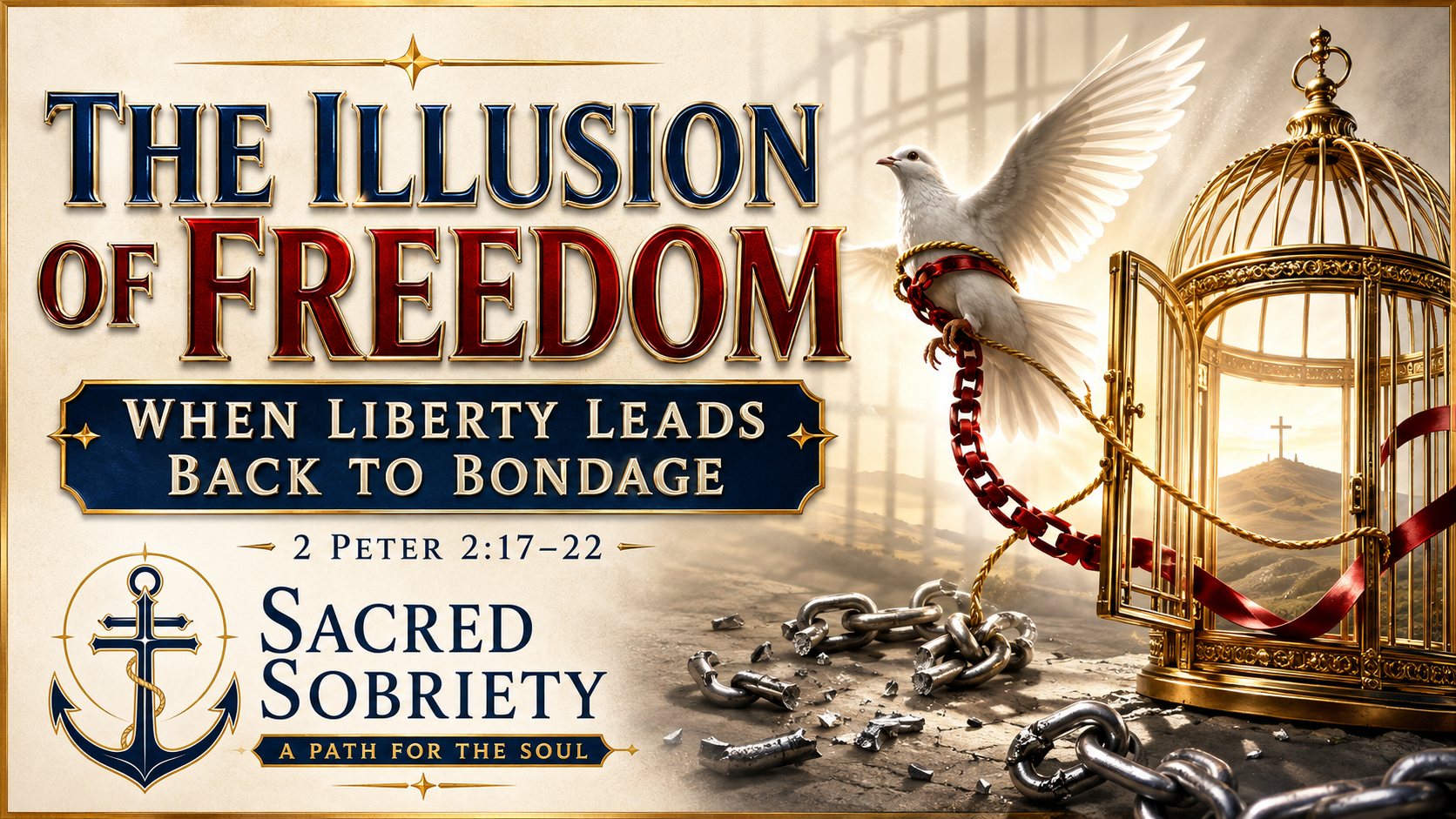
The Illusion of Freedom When What Promises Liberty Leads Back to Bondage
Anchor Scripture: 2 Peter 2:17–22
“While they promise them liberty, they themselves are the servants of corruption: for of whom a man is overcome, of the same is he brought in bondage.” — 2 Peter 2:19
Reader’s Note: We are entering the final three days of our Spiritual Resilience journey through Second Peter, and Peter is now bringing several of the themes we have explored into one sobering conclusion. This article reflects one of those closing themes from the forthcoming Spiritual Resilience devotional project. It is not the complete devotional entry, but an adapted teaching intended to help us consider Peter’s warning in the context of recovery, discipleship, boundaries, relapse prevention, and genuine freedom in Jesus Christ.
Freedom Sounds Wonderful—Until the Thing Promising Freedom Becomes Your Master
Freedom is one of the easiest promises to believe because every one of us longs to breathe again somewhere. We want freedom from shame, freedom from painful memories, freedom from controlling relationships, freedom from anxiety, freedom from addiction, freedom from other people’s expectations, and sometimes simply freedom from having to feel what hurts. There is nothing inherently wrong with that desire. Yet Peter closes the second chapter of his second epistle with an unsettling warning: not everything promising liberty actually knows the way to freedom.
Some forms of bondage do not approach us wearing chains. They approach us offering relief. Addiction says, “You deserve to feel better.” Resentment says, “You never have to become vulnerable again.” Isolation says, “No one can disappoint you if you stop depending upon anyone.” Control says, “Everything will be all right if you can manage the outcome.” People-pleasing promises acceptance. Compulsive independence promises protection. The problem is not that these promises contain no appeal; the problem is that they frequently demand increasing authority over our life in exchange for temporary relief.
That is why Peter’s language deserves our attention. He describes false teachers as “wells without water” and warns that while they promise liberty, they remain servants of corruption themselves. A dry well is deceptive precisely because it looks like the place where thirsty people should find water. The expectation is real, the thirst is real, and the need is real, but the source cannot provide what it promises. In much the same way, counterfeit freedom frequently offers something we genuinely need—rest, connection, dignity, safety, relief, acceptance—but directs that need toward something incapable of sustaining us.
As we approach the conclusion of our Spiritual Resilience series, this becomes an important question of discipleship and recovery: What have I been calling freedom that is actually exercising power over me? Paul wrote, “All things are lawful unto me, but all things are not expedient… I will not be brought under the power of any” (1 Corinthians 6:12). The question is not merely whether we are permitted to do something. Spiritual resilience requires us to ask whether that thing has begun possessing authority over our thoughts, choices, emotions, relationships, and obedience to Christ.
Anchor Verse — “Of Whom a Man Is Overcome”
Peter’s warning reaches its center in 2 Peter 2:19: “For of whom a man is overcome, of the same is he brought in bondage.” That verse provides an unexpectedly practical definition of bondage. Whatever continually overcomes us, commands us, controls our responses, overrides our convictions, or persuades us to compromise what we know is right has begun functioning as a master.
This connects directly with Peter’s larger message throughout the epistle. Second Peter began with a call to spiritual growth: faith joined with virtue, knowledge, temperance, patience, godliness, brotherly kindness, and charity (2 Peter 1:5–7). Peter did not describe Christian maturity as passive belief. He described a life increasingly governed by Christlike character. Now, near the end of chapter two, he shows us the opposite trajectory. Instead of growing in temperance and truth, a person may surrender themselves again to appetites, deception, corruption, and patterns capable of overcoming them.
That contrast helps us understand spiritual resilience. Resilience is not merely surviving hardship. It is developing enough spiritual rootedness that pressure, appetite, fear, resentment, loneliness, pride, temptation, and disappointment do not continually become our masters. Peter is bringing us back to the question of authority. Who—or what—is shaping the direction of our life?
Before We Go Deeper: Freedom Is More Than Escape
Many of us understand freedom primarily as getting away from something. We stopped drinking. We ended the destructive relationship. We left the unhealthy environment. We stopped rescuing people. We established a boundary. We walked away from the compulsive behavior. Those moments may represent tremendous breakthroughs, and we should never minimize the grace and courage required to make them.
Yet escape is not the same thing as transformation. Paul tells believers to “put off” the old person, become renewed in the spirit of their mind, and “put on the new man” (Ephesians 4:22–24). Recovery therefore involves both removal and replacement. We are not merely learning what we must stop doing. We are learning an entirely different way of thinking, responding, relating, grieving, resting, trusting, worshiping, loving, and walking with God.
That is what makes Peter’s warning about becoming “again entangled” so significant. Something may have been escaped while the deeper appetite remains unaddressed. The substance may disappear while the hunger for escape continues. The destructive relationship may end while fear of abandonment remains. Rescuing may decrease outwardly while anxiety about other people’s choices continues dominating our thoughts. Spiritual resilience develops as the grace of Christ begins transforming not only what we leave behind, but who we are becoming as we move forward.
When the Promise of Freedom Becomes Another Master
Peter describes deceptive voices as “wells without water” in 2 Peter 2:17. The image is intentionally powerful. Imagine approaching a well after traveling through heat and exhaustion, believing relief is finally within reach, only to discover there is nothing there capable of satisfying your thirst. The promise was not merely disappointing; it directed your legitimate thirst toward an empty source. Jeremiah uses similar imagery when God says His people had forsaken “the fountain of living waters” and made for themselves “broken cisterns, that can hold no water” (Jeremiah 2:13).
Counterfeit freedom operates in much the same way. Something within us is genuinely thirsty. We may crave peace, dignity, comfort, belonging, intimacy, safety, affirmation, rest, justice, or relief from overwhelming emotion. Instead of bringing that thirst honestly before God and allowing Him to teach us healthier ways of responding, we may return to whatever previously promised immediate satisfaction. The old behavior whispers that it can still provide what we need, even when our own history testifies otherwise.
Jesus gives us a completely different definition of liberty: “If ye continue in my word… ye shall know the truth, and the truth shall make you free” (John 8:31–32). Freedom, according to Christ, is inseparable from truth. It is not merely the unrestricted ability to do whatever we desire in the moment. Genuine freedom means we increasingly possess the spiritual capacity to recognize deception, refuse what destroys us, receive correction without collapsing into shame, establish healthy boundaries without becoming hardened, and choose obedience when another path promises easier relief.
Paul develops this same principle in Romans 6:16 when he asks whether we understand that the one to whom we continually yield ourselves becomes the one we serve. This is difficult language in a culture where freedom is often defined as personal autonomy. Yet Scripture repeatedly asks us to examine what governs us. What continually commands our attention? What determines whether we feel secure? What are we terrified of losing? What do we defend even when its fruit is becoming destructive? What repeatedly persuades us to violate the convictions we once believed were necessary?
This is also why self-control should never be viewed as the enemy of freedom. Peter tells believers to add temperance to knowledge (2 Peter 1:6), and Paul identifies temperance—self-control—as fruit of the Spirit in Galatians 5:22–23. The person who must obey every impulse is not truly free. The person who must respond to every offense, satisfy every craving, answer every accusation, fix every crisis, receive everyone’s approval, or escape every uncomfortable emotion is still being governed by something.
Genuine liberty gives us room between impulse and response. Through the grace of Christ and the work of the Holy Spirit, we can pause. We can pray. We can examine what is happening within us. We can ask whether the thing promising immediate relief is actually leading toward life. James writes, “Submit yourselves therefore to God. Resist the devil, and he will flee from you” (James 4:7). Notice the order: surrender comes before resistance. Spiritual freedom develops when our will becomes increasingly anchored beneath the authority of God rather than whichever appetite speaks most loudly.
Peter’s warning is therefore not an argument against freedom. It is an invitation to recognize the difference between liberty and illusion. Genuine freedom strengthens our ability to live truthfully, responsibly, lovingly, and faithfully before God. Counterfeit freedom gradually diminishes that ability while continuing to insist that we are simply exercising our independence. The question is not whether we can do something. The deeper question is whether doing it repeatedly is making us more capable of following Christ—or less capable of saying no when something else demands our allegiance.
Recovery Focus — Entangled Again: Relapse Begins Before the Return
Peter intensifies his warning in 2 Peter 2:20 when he speaks of those who had escaped corruption and then became “again entangled therein, and overcome.” That word again deserves our attention. Peter is describing a return. Something was recognized. Something was escaped. Something lost its former authority. Yet over time, the person moved close enough to the old bondage that it began wrapping itself around them again.
This is one of the most important realities we can understand about relapse and recovery: the visible return is frequently not the beginning of relapse. Long before someone takes the drink, makes the bet, returns to pornography, reconnects with the destructive relationship, resumes the compulsive behavior, or crosses the boundary, something may already be shifting internally. Isolation begins increasing. Prayer becomes inconsistent. Accountability feels irritating. Resentment goes unchallenged. Emotional exhaustion accumulates. Honesty decreases. What once appeared dangerous begins looking manageable again.
Paul warns, “Let him that thinketh he standeth take heed lest he fall” (1 Corinthians 10:12). That is not an invitation to live terrified of failure. It is an invitation to humility. Years of sobriety, recovery experience, biblical knowledge, ministry, counseling, meetings, therapy, or spiritual maturity do not make us invulnerable. Sometimes one of the most dangerous thoughts we can entertain is the belief that because we have grown, the boundaries that helped us grow are no longer necessary.
Counterfeit freedom frequently whispers, “You are different now. You can handle it.” Perhaps the person recovering from alcohol begins wondering whether one drink would really matter anymore. Someone who escaped a destructive relationship begins believing one conversation cannot hurt. The compulsive rescuer decides this particular crisis is different and surely requires intervention. The person who once required accountability begins believing that needing support demonstrates weakness rather than wisdom. Slowly, freedom becomes something we assume rather than something we faithfully steward.
Paul tells the Galatians, “Stand fast therefore in the liberty wherewith Christ hath made us free, and be not entangled again with the yoke of bondage” (Galatians 5:1). Notice that believers who possess liberty are still commanded to stand fast in it. Freedom is a gift from Christ, but that gift calls for faithful stewardship. There are certain places God has delivered us from that we do not need to revisit merely to prove we have changed.
The writer of Hebrews similarly urges us to “lay aside every weight, and the sin which doth so easily beset us” so that we may run with endurance the race before us (Hebrews 12:1). Some things become weights before they become obvious bondage. They weaken our attention, disrupt our spiritual rhythm, exhaust our emotional resources, and gradually make old responses more attractive. Spiritual resilience means noticing the weight while we still possess enough clarity to put it down.
Yet Peter’s warning should never be weaponized against the person who struggles. Peter himself knew catastrophic failure. He denied knowing Jesus three times, yet the risen Christ met him, restored him, recommissioned him, and entrusted him with the care of His people in John 21:15–19. Temptation is not the same as surrender. Vulnerability is not the same as defeat. Even relapse does not place someone beyond the reach of grace. The purpose of biblical warning is not hopelessness; it is awakening. Christ calls us to recognize the entanglement early enough to turn again toward truth, community, accountability, and grace.
Wisdom and Grace — Guarding Freedom Without Living Afraid
One of the clearest ways we protect spiritual freedom is through healthy boundaries. For some of us, however, the word boundary immediately sounds restrictive because boundaries were once used against us as methods of punishment, manipulation, control, or rejection. Yet Scripture also presents boundaries as expressions of wisdom. Proverbs 4:23 tells us to “keep thy heart with all diligence; for out of it are the issues of life.” Guarding our heart does not mean becoming closed, suspicious, or emotionally inaccessible. It means taking seriously what we repeatedly allow to influence us.
Psalm 119:45 provides a beautiful paradox: “I will walk at liberty: for I seek thy precepts.” The psalmist does not experience God’s instruction as the opposite of freedom. He discovers liberty through walking within truth. In the same way, a guardrail on a mountain road does not exist to prevent the traveler from reaching the destination. It helps keep the traveler from leaving the road in a place where the consequences may become devastating.
There are times when freedom looks like maintaining a boundary rather than proving we no longer need one. Someone living in long-term sobriety may remain completely free while continuing to avoid environments that unnecessarily awaken old associations. Someone recovering from a toxic relationship may practice forgiveness without restoring unrestricted access. Someone overcoming people-pleasing may listen respectfully to another person’s disappointment without automatically changing direction simply to recover their approval. Someone overcoming rescuing may remain compassionate while allowing another adult to experience the consequences of their own decisions.
Wisdom also teaches us that boundaries are not walls. A healthy boundary identifies responsibility and protects what God is restoring. A wall assumes that safety requires permanent disconnection from everyone. Scripture does not call us to isolated self-sufficiency. Galatians 6 tells us both to bear one another’s burdens and to carry the responsibilities that properly belong to us. Healthy community strengthens agency rather than erasing it. Healthy accountability increases responsibility rather than creating dependency.
This is where grace becomes indispensable. We will not guard freedom perfectly. There may be moments when we recognize warning signs later than we wanted. We may reopen a conversation we should have left closed, over-function for someone, isolate, become defensive, lose our temper, neglect healthy routines, or discover that an appetite we thought was gone has begun speaking again. Hebrews 4:16 tells us to come boldly to the throne of grace so that we may obtain mercy and find grace “to help in time of need.” Grace is available while we need help, not merely after we have successfully repaired ourselves.
Wisdom therefore does not ask, “How close can I get to bondage while remaining technically free?” Wisdom asks, “What helps me remain close to Christ?” That question changes the entire orientation of recovery. Instead of proving our strength, we begin stewarding what grace has restored. Instead of testing boundaries unnecessarily, we protect the environment in which truth, connection, emotional health, responsibility, worship, and Christlike character can continue growing.
The F.R.E.E. Practice — A Framework for Genuine Liberty
Peter’s warning leaves us with an important question: What have we been calling freedom that may actually be exercising power over us? Answering that honestly requires something more useful than vague intentions. We need a framework that helps us recognize bondage, evaluate its promises, surrender what we cannot control through self-will, and replace old patterns with practices that lead us toward life.
The F.R.E.E. Practice provides that framework: Face the bondage honestly. Reject counterfeit freedom. Embrace healthy surrender. Establish life-giving practices. This is not another formula for earning grace. It is a practical way of participating in the freedom Christ provides and becoming attentive to areas where old masters may be attempting to reclaim authority.
F — Face the Bondage Honestly
“Search me, O God, and know my heart.” — Psalm 139:23
Freedom begins with truth. David prayed, “Search me, O God, and know my heart: try me, and know my thoughts… and lead me in the way everlasting” (Psalm 139:23–24). That is an extraordinarily courageous prayer because David is not asking God merely to validate his existing interpretation. He is giving God permission to expose what David himself may not recognize clearly.
Bondage survives remarkably well through minimization, rationalization, concealment, selective memory, and comparison. We convince ourselves that something is not serious because someone else appears worse. We emphasize how far we have come while ignoring what has recently begun deteriorating. We rename the pattern until it sounds harmless. Yet 1 John 1:8 warns that when we deny what is true about ourselves, we become capable of deceiving ourselves.
Facing bondage honestly therefore requires examining fruit. Jesus said, “By their fruits ye shall know them” (Matthew 7:20). What does this relationship, habit, resentment, appetite, or pattern consistently produce? Does it produce honesty, responsibility, peace, connection, humility, and spiritual stability? Or does it produce secrecy, confusion, anxiety, defensiveness, compromise, exhaustion, and isolation? Naming what something is does not give it power. Bringing it into the light removes some of the secrecy through which its power has been operating.
R — Reject Counterfeit Freedom
“Stand fast therefore in the liberty wherewith Christ hath made us free.” — Galatians 5:1
Once we identify bondage, we must identify the promise attached to it. Every destructive pattern promises something. Addiction promises relief. Control promises certainty. Resentment promises protection. Isolation promises safety. People-pleasing promises belonging. Rescuing promises significance. Compulsive independence promises that no one will ever possess enough power to hurt us again.
Proverbs 14:12 warns, “There is a way which seemeth right unto a man, but the end thereof are the ways of death.” Counterfeit freedom usually emphasizes the immediate benefit while concealing the eventual cost. Peter’s “wells without water” offer the appearance of satisfaction without possessing anything capable of sustaining the thirsty person. Jeremiah’s “broken cisterns” offer the same image: something we keep asking to hold what it has repeatedly demonstrated it cannot hold.
Rejecting counterfeit freedom means learning to interrogate the promise. When an old behavior says, “This will make you feel better,” remember what it produced before. When isolation says, “No one understands you,” remember where prolonged disconnection historically leads. When resentment says, “You need this to protect yourself,” examine whether bitterness has actually created peace. When the old relationship begins looking attractive again, remember the whole story rather than allowing loneliness to edit the consequences from your memory.
E — Embrace Healthy Surrender
“Submit yourselves therefore to God.” — James 4:7
For people whose history includes control, abuse, manipulation, or codependency, surrender can sound dangerous. Biblical surrender, however, is not allowing another human being to dominate us. It is voluntarily placing our will beneath the wisdom and lordship of Jesus Christ. James 4:7 gives us the order plainly: “Submit yourselves therefore to God. Resist the devil, and he will flee from you.”
We frequently want the power of resistance without accepting the humility of surrender. We want enough knowledge, determination, discipline, recovery experience, or spiritual maturity to manage everything ourselves. Yet some of the most liberating words we can speak are, “I cannot control this.” I cannot control another adult’s choices. I cannot guarantee someone’s approval. I cannot rewrite yesterday. I cannot make temptation permanently disappear. I cannot force another person to respect my boundary. What I can do is surrender what I cannot control and become responsible for the choices God has placed within my stewardship.
Jesus modeled this in Gethsemane when He prayed, “Nevertheless not my will, but thine, be done” (Luke 22:42). His surrender was not weakness but perfect alignment with the Father. Our surrender may sound far less dramatic: “Lord, I cannot control what they choose, but I can control whether I continue rescuing them. I cannot guarantee that this craving disappears tonight, but I can refuse to feed it. I cannot change what happened to me, but I can stop allowing that wound to determine every relationship I enter.” Surrender restores our agency by placing it beneath trustworthy authority.
E — Establish Life-Giving Practices
“Walk in the Spirit, and ye shall not fulfil the lust of the flesh.” — Galatians 5:16
Recovery cannot remain organized entirely around what we are trying not to do. Eventually, the spaces once occupied by addiction, isolation, resentment, control, compulsive relationships, or emotional escape must begin filling with something capable of supporting life. Paul describes this as walking in the Spirit. Walking is repetitive movement—one ordinary step followed by another.
Freedom becomes resilient through repeated practices. We pray again. We open Scripture again. We tell the truth again. We attend the meeting again. We call the trusted person again. We keep the boundary again. We rest before exhaustion becomes desperation. We apologize when necessary. We forgive without pretending the wound never happened. We refuse the impulse to respond immediately when wisdom is telling us to slow down. None of these actions earns grace; they help us participate faithfully in the grace God has already provided.
Paul describes what a Spirit-shaped life increasingly produces: “love, joy, peace, longsuffering, gentleness, goodness, faith, meekness, temperance” (Galatians 5:22–23). Compare that fruit with bondage. Addiction produces compulsion; the Spirit develops temperance. Control feeds anxiety; the Spirit cultivates peace. Resentment feeds hostility; the Spirit develops gentleness. Isolation disconnects us; the Spirit teaches love. Healthy spiritual practices gradually create an environment in which these qualities can take deeper root.
Reflection of Thought — What Have You Been Calling Freedom?
Fellow travelers, one of the most difficult things about counterfeit freedom is that it rarely feels like bondage at first. It often sounds reasonable. Perhaps even compassionate. We tell ourselves we have suffered enough, sacrificed enough, grown enough, or remained disciplined long enough that the old safeguards should no longer matter. Yet Peter challenges us to look beyond the language we use and examine what actually possesses power over us.
One revealing question is this: What happens inside me when I cannot have, control, fix, defend, revisit, or receive the thing I want? If losing access to something immediately produces desperation, secrecy, manipulation, panic, rage, obsessive thinking, or intense defensiveness, that reaction may be telling us something about the authority it possesses. Paul’s concern was not merely whether something was lawful. He refused to be “brought under the power of any” (1 Corinthians 6:12).
We should also examine what our memory has begun romanticizing. Peter speaks of becoming “again entangled,” and recovery teaches us how easily memory becomes selective. Israel remembered the food of Egypt while forgetting what Egypt had actually been: slavery (Numbers 11:4–6). We can do exactly the same thing. We remember the laughter and forget the hangover. We remember companionship and forget manipulation. We remember excitement and forget instability. We remember being needed and forget how exhausted rescuing made us. Selective memory can make old bondage appear like lost freedom.
Yet remembrance does not require living imprisoned by our past. Paul writes about forgetting what lies behind and reaching toward what lies ahead as he presses toward Christ (Philippians 3:13–14). He is not denying his history. He is refusing to allow yesterday to become tomorrow’s destination. Healthy remembrance tells the whole truth about where we have been while keeping our face turned toward where Christ is leading us.
Perhaps that is one of the greatest lessons Peter leaves us as this Spiritual Resilience journey begins moving toward its conclusion. Resilience is not the confidence that we could never become entangled again. It is the humility to recognize what can entangle us, the wisdom to notice when something begins pulling backward, the courage to tell the truth early, and the grace to turn toward Christ before an old pattern becomes an old master once more.
Challenge for Today: Guard What Grace Has Given You
Today, do not ask yourself whether you are strong enough to revisit what once enslaved you. Ask what will help you remain faithful to the freedom Christ is building within you. Set aside fifteen or twenty quiet minutes with 2 Peter 2:17–22, Galatians 5:1, Psalm 139:23–24, and John 8:36, and work through this practical freedom inventory:
- Name what is pulling at you. Identify one substance, relationship, resentment, fear, behavior, appetite, emotional reaction, or old survival strategy that has recently received more of your attention.
- Examine the fruit. Ask what this pattern is actually producing in your spiritual life, emotional stability, relationships, integrity, recovery, and ability to remain present with God.
- Identify the promise. Complete the sentence: “This keeps promising me that it will give me ______.” Then ask whether it has historically delivered what it promises.
- Remember the whole story. Write down what the old bondage actually cost you. Do not allow nostalgia, loneliness, anger, or appetite to edit the consequences.
- Restore one boundary. Identify one practical safeguard that needs strengthening today. That may mean deleting a number, leaving an environment, limiting access, attending a meeting, stepping away from an argument, changing a routine, or refusing to rescue someone from a responsibility that belongs to them.
- Reach toward safe community. Tell one trustworthy person what you are noticing before secrecy gives the pattern more authority.
- Replace rather than merely remove. Choose one life-giving practice for the space you are protecting: prayer, Scripture, rest, exercise, counseling, a recovery meeting, journaling, worship, healthy fellowship, creative work, or service.
- Surrender the outcome. Pray honestly: “Lord, show me what is mastering me. Give me wisdom to recognize counterfeit freedom, courage to release what is pulling me backward, and grace to remain established in the liberty You have given me.”
The challenge is not perfection. The challenge is attention. Notice what is happening before it becomes louder. Tell the truth before secrecy grows. Restore the boundary before compromise becomes a pattern. Reach out before isolation becomes comfortable. Surrender before self-will convinces you that you must manage everything alone.
Jesus said, “If the Son therefore shall make you free, ye shall be free indeed” (John 8:36). That freedom does not require us to prove our strength by returning to our chains. It gives us the grace to recognize what once enslaved us, refuse the counterfeit promise, remain teachable, practice wisdom, and continue moving toward the abundant life Christ has placed before us.
Christ has made us free. Spiritual resilience teaches us how to remain rooted in that freedom.


No comments:
Post a Comment