There is a practical truth contained within the simple statement, “Everything you need.” Peter does not say that God has given us everything we want, everything we imagine, or everything we believe will make life easier. He declares that everything required for us to pursue life and godliness through Jesus Christ has already been made available.
And yet, this is the dilemma many of us face in recovery. The truth that God has already provided everything we need can sound almost too simple to understand, trust, or receive. A life shaped by powerlessness, dysfunction, and the inability to manage our own affairs often trains us to look outward for validation. We learn to perform, prove ourselves, impress others, and secure whatever we believe might protect us from feeling inadequate, unwanted, or empty.
In essence, we become accustomed to believing that we must have more because, at some point, we felt we had nothing. That sense of lack may quietly shape our desires, relationships, ambitions, and even our spirituality. Instead of receiving what God has already provided through Christ, we continue striving for approval, control, attention, comfort, or security.
For me, it took time to understand the importance of slowing down, waiting upon the Lord, placing my faith and trust in Him, and recognizing that everything I truly needed had already been provided. I did not need to beg, plead, bargain, or convince God to help me. And trust me, I became very skilled at negotiating with Him.
You know the kind of negotiation:
“Lord, if You help me out just this one time, I promise I will read my scriptures. I promise I will pray more. I promise I will do better.”
I often treated God as a means of rescuing me from the consequences of my own dysfunction. Once the immediate crisis passed, I pushed Him onto the back burner and returned to living according to my own desires.
Anchor Verse: “According as his divine power hath given unto us all things that pertain unto life and godliness, through the knowledge of him that hath called us to glory and virtue.” —2 Peter 1:3
What comes to mind is the promise Christ gave in John 10:9–11: “I am the door: by me if any man enter in, he shall be saved, and shall go in and out, and find pasture. The thief cometh not, but for to steal, and to kill, and to destroy: I am come that they might have life, and that they might have it more abundantly. I am the good shepherd: the good shepherd giveth his life for the sheep.”
The abundant life promised through Christ becomes the lived reality of Peter’s declaration. Everything we need to receive this abundant life has been provided through Him. We accept this provision as we step out in faith and onto the path of covenant relationship, where we continue growing in Christ.
This is how we move from merely surviving along our recovery journey toward thriving in sobriety. The fruit is an abundant life rooted not in what we possess, control, or accomplish, but in who Jesus Christ is.
Grace and Peace Multiplied
Peter begins by saying: “Grace and peace be multiplied unto you through the knowledge of God, and of Jesus our Lord.” —2 Peter 1:2
Grace and peace are not merely given once and left behind at the beginning of faith. They are multiplied as our knowledge of Christ deepens.
Many of us have spent years attempting to accumulate security through approval, relationships, possessions, control, or performance. Peter directs us toward a different source. Grace and peace increase, not because every circumstance suddenly becomes manageable, but because we are growing in our knowledge of God and learning to trust Jesus Christ.
To know Christ means more than possessing information about Him. We may know religious language, remember familiar verses, attend worship, and understand doctrine while continuing to live as though Christ cannot be trusted with our lives.
Jesus said: “My sheep hear my voice, and I know them, and they follow me.” —John 10:27
Knowing Christ is personal, relational, and transforming. We become familiar with His voice, trust His promises, follow His direction, and allow our lives to be reordered according to His will.
Our spiritual strength is not found in becoming more self-sufficient. It is found in becoming more dependent upon Christ.
Called Toward a New Life
Peter says that Christ has “called us to glory and virtue” (2 Peter 1:3). We are not only rescued from addiction, dysfunction, sin, or destructive relationships. We are called toward a new way of living.
Recovery and sobriety involve more than removing alcohol, drugs, compulsive behaviors, toxic attachments, or destructive patterns. We are called to develop honesty, integrity, holiness, courage, patience, compassion, self-control, and faithfulness.
Christ does not only call us away from what once enslaved us. He calls us forward into a life shaped by His transforming grace.
Peter also speaks of God’s “exceeding great and precious promises” (2 Peter 1:4). This matters because many of us have lived according to promises that could never deliver what they offered.
Addiction promised relief but increased suffering. Dysfunction promised protection while keeping us trapped in fear. Codependency promised belonging while encouraging us to abandon healthy boundaries. Our desires promised satisfaction but often left us emptier than before.
God’s promises are different because He is faithful.
When fear says we will never change, shame says we are beyond redemption, or temptation tells us to return to old behaviors, we may anchor ourselves in what God has spoken.
Grace for the Recovery Journey
Recovery begins to deepen when we stop asking destructive patterns to provide what only Christ can give. The peace we sought through escape, the confidence we sought through performance, and the security we sought through control are found more fully as we learn to know and trust Jesus Christ.
This does not mean recovery suddenly becomes effortless. It means we are no longer without help, direction, or spiritual provision.
There will be days when cravings return, emotions become overwhelming, memories surface, or old patterns begin to feel familiar. In those moments, weakness is not proof that grace has failed. It may become the place where we learn to depend more fully upon the strength Christ provides.
Spiritual resilience develops in the pause between what we feel and how we respond.
“Be still, and know that I am God.”
—Psalm 46:10
In recovery, stillness may mean refusing to act impulsively, waiting before sending the message, choosing not to return to an unsafe relationship, calling someone we trust, praying through a craving, or allowing an uncomfortable emotion to pass without numbing it.
Not every desire must be obeyed. Not every feeling must determine our next decision.
God’s provision also includes community. Everything we need does not mean we are meant to recover alone. Grace may come through people who pray with us, speak truth to us, sit with us in discomfort, and remind us of what we are tempted to forget.
Reaching out is not evidence of failure. It is an act of wisdom, humility, and faithful participation.
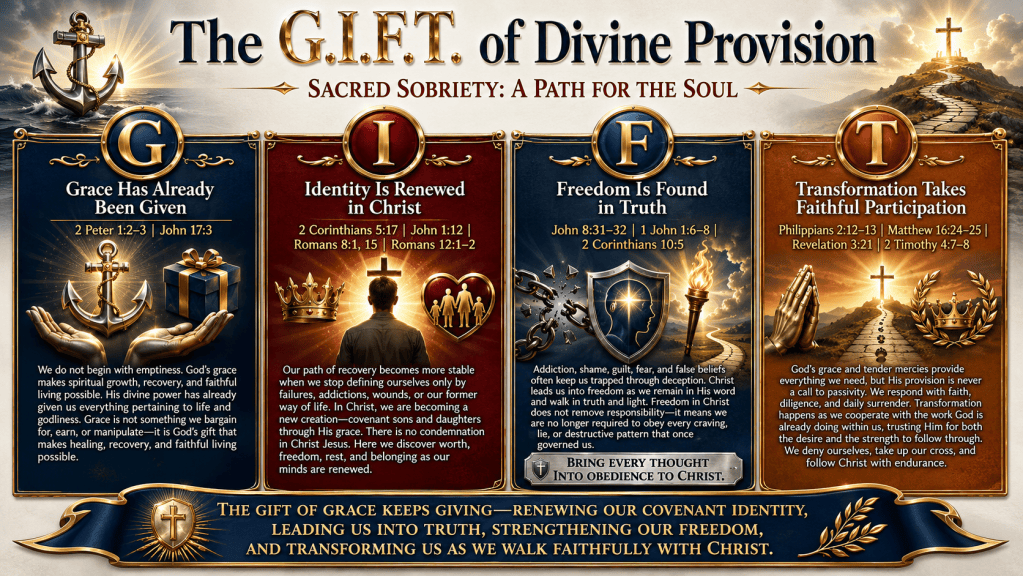
The G.I.F.T. of Divine Provision
G — Grace Has Already Been Given - Anchor verses: 2 Peter 1:2–3: We do not begin with emptiness. God’s grace makes spiritual growth, recovery, and faithful living possible. “And this is life eternal, that they might know thee the only true God, and Jesus Christ, whom thou hast sent.” —John 17:3. His divine power has already given us everything pertaining unto life and godliness. Grace is not something we need to bargain for, earn, or manipulate from God. It is the very gift that makes spiritual growth, recovery, and faithful living possible.
I — Identity Is Renewed in Christ - Anchor verse: 2 Corinthians 5:17 - Our path of recovery and sobriety becomes more stable when we stop defining ourselves only by our failures, addictions, wounds, or former way of life. In Christ, we are invited into a renewed identity. We are not merely people attempting to avoid our past. We are becoming covenant sons and daughters—a new creation—through the transforming grace of Jesus Christ. We are not defined only by our addictions, wounds, failures, or former way of life. In Christ, we are becoming new. “But as many as received him, to them gave he power to become the sons of God, even to them that believe on his name.” —John 1:12.
Through the Spirit of adoption, we recognize that we are children of God (Romans 8:15). We also remember that: “There is therefore now no condemnation to them which are in Christ Jesus.” —Romans 8:1.
This is where we discover our worth, freedom, rest, and belonging. As we grow in faith and covenant relationship, we present ourselves as living sacrifices, holy and acceptable unto God. We are transformed through the renewing of our minds rather than conformed to the patterns of this world (Romans 12:1–2).
F — Freedom Is Found in Truth: Anchor verses: John 8:31–32 - Addiction, dysfunction, shame, guilt, doubt, and fear often keep us trapped through deception. Christ leads us toward freedom by teaching us to remain in His word so that we may walk in truth and light (1 John 1:6–8). Freedom in Christ does not mean there is an absence of responsibility. It means that we are no longer required to obey every craving, false belief, or destructive pattern that once governed us.
For me, freedom came from confronting a busy and restless mindset. I lived on high alert—anxious, overthinking, depressed, and weighed down by self-deprecating dialogue, criticism, and verbal assaults that had accumulated over the years. Freedom began when I finally understood what Paul meant when he instructed the Christians at Corinth to bring every thought into obedience to Christ (2 Corinthians 10:5).
My mind is no longer as restless as it once was. My anxiety is no longer constantly on high alert, and depression now comes and goes less frequently. Yet this required a great deal of work because the spiritual battle was taking place within my mind.
We are no longer required to obey every craving, false belief, or destructive pattern that once governed us.
T — Transformation Takes Faithful Participation: Anchor verses: Philippians 2:12–13 - Our Heavenly Father, through His grace and tender mercies, has provided everything we need. However, His provision is never a calling into passivity. We are invited to respond with faith, diligence, and daily surrender.
Transformation occurs as we cooperate with the work God is already accomplishing within us, trusting that He gives us both the desire and the strength to follow through. Christ established the process through which transformation takes place, along with the faithful participation and patience required to endure and overcome.
First, we must be willing to deny ourselves. Second, we must take up our cross and follow Him. Through this process, the Savior promises that when we lose our life for His sake, we shall find it (Matthew 16:24–25). He also promises: “To him that overcometh will I grant to sit with me in my throne.” —Revelation 3:21Paul reminds Timothy that he had fought a good fight, finished his course, and kept the faith. He looked forward to the crown of righteousness laid up for him (2 Timothy 4:7–8).
The gift of grace keeps giving because it continues to renew our covenant identity, lead us into truth and understanding, strengthen our freedom, and transform us as we walk faithfully with Christ.
Where This Meets Your Recovery Journey
James writes: “But be ye doers of the word, and not hearers only, deceiving your own selves.” —James 1:22
It is not enough to agree that God has provided what we need. We must consider whether our choices reflect that belief.
Take a moment to reflect:
- Where do you still feel as though you do not have enough?
- What false promise has addiction, codependency, fear, or shame offered you?
- Where might God already be providing help through Scripture, prayer, community, counsel, or healthy boundaries?
- What is one practical decision that would reflect trust in God’s provision today?
You may not feel strong enough for the entire road ahead, but you are not being asked to walk the entire road today.
Grace meets you in the present moment. Wisdom is available for the next decision. Support is available when you are willing to reach for it.
Receive the truth. Use the support. Practice wisdom. Take the next faithful step.

About the forthcoming print edition
This devotional is adapted from the forthcoming Spiritual Resilience: Growing in Grace Through 2 Peter print devotional. The expanded edition will include fuller biblical teaching, extended recovery applications, additional personal reflections, the complete G.I.F.T. study, expanded questions, prayers, and material designed to accompany the Spiritual Resilience Companion Study Guide and Journal.


No comments:
Post a Comment