
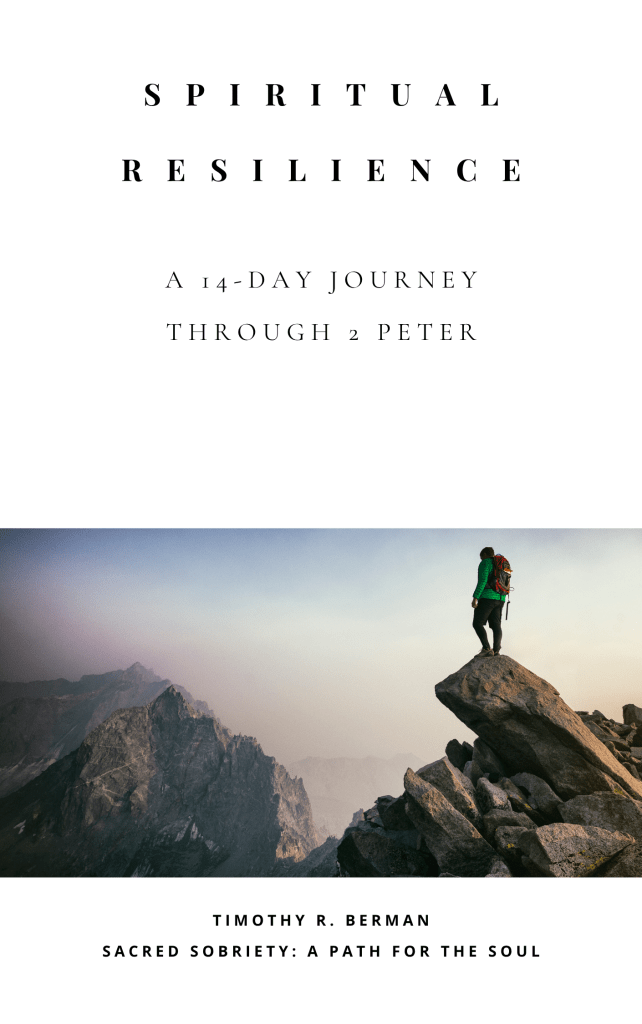
From the upcoming Spiritual Resilience: A 14-Day Journey through 2 Peter
Consider a builder who possesses the finest blueprints, the strongest materials, and every tool necessary to complete the work given to him. Despite having everything required, nothing will be built until those resources are intentionally used. Lumber stacked beside an unfinished foundation does not become a shelter. Tools left inside a locked toolbox will never strengthen a wall. A blueprint may be carefully studied and deeply admired, yet it cannot become a finished home until someone begins the building process.
The same principle applies to our own faith and our own recovery journey.
Faith is a gift from our Heavenly Father and the foundation of our spiritual lives. However, the Lord never intended for our faith to remain undeveloped, untested, or disconnected from the way we live. Faith is not merely something we profess, defend or privately possess. It is meant to become the foundation upon which God develops our spiritual character and integrity. Faithful obedience, emotional maturity, and enduring spiritual resilience becomes the fruit of our faith in Christ.
The Apostle Pater was writing to believers who had already received grace, received faith, and the promises of God. These were not blessings they had purchased through any form of religious performance or effort; nor, earned through any personal merit. However, Peter still called them to participate diligently in what God had already given them. Divine grace supplied the necessary foundation, the materials, the strength, and the opportunity for growth. Discipleship required them to begin building upon that foundation.
Anchor verse: "And beside this, giving all diligence, add to your faith virtue; and to virtue knowledge" (2 Peter 1:5)
Spiritual resilience begins developing as faith is strengthened through the Christian virtues of a spiritually Christian disciplined life - one that is consistently crucified unto Christ. It is also strengthened through knowledge - learning line upon line precept upon precept, and here a little and there a little. It is also strengthened through temperance, patience, godliness, brotherly kindness, and charity. These qualities do not replace our faith or compete with God's grace. They reveal what happens when faith becomes active in our own lives, grace becomes transformational, and the life of Christ begins producing visible fruit within us.
This principle is especially important for those of us walking a path of recovery and learning how to thrive in sobriety. See, fellow travelers, Sobriety does not stabilize our lives because we desire a different future. Desire may awaken us to the need for change, yet lasting transformation requires willingness that moves toward accountability. Faith needs to begin shaping our mindset, relationships, boundaries, habits, decisions, reactions, and responses.
Prayer, meetings, inventories, healthy boundaries, supportive relationships, accountability, service, and changed behavior do not earn the grace of God. They are ways we begin to live faithfully within the grace we have already received. Grace empowered becomes grace expressed, and grace expressed, becomes grace endured.
Peter, therefore, invites us to stop treating faith as a passive possession and invites us to begin the process of allowing God to build something enduring within us.
Grace Provides What We Need to Grow
Immediately before calling believers to add spiritual character to their faith, Peter declares that God’s “divine power hath given unto us all things that pertain unto life and godliness” through the knowledge of Jesus Christ (2 Peter 1:3).
That promise protects us from believing that spiritual transformation depends entirely upon our own strength. We have not been abandoned to repair ourselves, rescue ourselves, or manufacture holiness through white-knuckled determination. God supplies what we cannot create for ourselves. His grace awakens faith. His Spirit gives us strength. His Word provides direction. His promises assure us that genuine transformation is possible.
However, divine provision does not eliminate faithful participation.
God has supplied what we need, and we are called to use what He has supplied. Grace does not merely forgive us and leave us unchanged. Grace teaches, corrects, disciplines, strengthens, and leads us into a new way of living. Peter moves naturally from what God has already provided to what believers are called to develop.
Grace lays the foundation. Diligence begins building upon it.
Peter begins this passage with the words, “And beside this.” He is connecting personal responsibility to everything God has already accomplished. We do not add virtue, knowledge, temperance, patience, godliness, kindness, and charity because grace is insufficient. We add these qualities because grace has made spiritual growth possible.
God does not rescue us from the guilt and consequences of our former lives only to leave our character, relationships, attitudes, and behaviors untouched. He brings us into a transforming covenant relationship in which faith becomes fruitful.
Peter’s words, “giving all diligence,” communicate intentionality, earnestness, and sustained effort. He does not tell us to consider spiritual growth whenever life becomes easier or more convenient. He calls us to bring faithful participation into the process of transformation.
We begin with faith, but we are not meant to remain at the beginning.
Faith becomes the foundation upon which God develops a life marked by moral courage, spiritual understanding, self-control, perseverance, godliness, compassion, and Christlike love.
Spiritual Growth Is the Fruit of Abiding in Christ
The qualities Peter names are not random religious achievements. They build upon and strengthen one another.
Faith gives us confidence to trust God. Virtue gives us the moral courage to act upon what we believe. Knowledge teaches us to discern truth from deception. Temperance helps us govern our desires, manage our emotions, and make wise decisions. Patience enables us to remain faithful when growth appears slow, difficult, or painful. Godliness aligns our lives with the character, purpose, and will of our Heavenly Father. Brotherly kindness teaches us to value fellowship and meaningful relationships. Charity develops within us the self-giving love revealed perfectly through Jesus Christ.
Peter explains:
“For if these things be in you, and abound, they make you that ye shall neither be barren nor unfruitful in the knowledge of our Lord Jesus Christ.”
— 2 Peter 1:8
Spiritual character is the fruit through which our knowledge of Christ becomes visible. Knowing Christ involves more than possessing information, memorizing scriptures, or being able to explain doctrine. It is a living relationship that produces transformation.
Jesus expressed this same truth through the image of the vine and the branches:
“Abide in me, and I in you. As the branch cannot bear fruit of itself, except it abide in the vine; no more can ye, except ye abide in me.
“I am the vine, ye are the branches: He that abideth in me, and I in him, the same bringeth forth much fruit: for without me ye can do nothing.”
— John 15:4–5
A branch cannot produce life independently from the vine. In the same way, we cannot produce lasting spiritual transformation apart from an abiding relationship with Jesus Christ.
Abiding means depending upon Christ for guidance, strength, correction, and spiritual nourishment. It includes prayer, communion with God, faithful obedience, remaining rooted in His Word, and continuing in His love. As we abide in Christ, the Holy Spirit begins producing within us love, joy, peace, patience, gentleness, goodness, faith, meekness, and temperance.
When Peter’s counsel is placed alongside the Savior’s teaching, the connection becomes unmistakable. The qualities Peter urges us to cultivate are the visible fruit of remaining connected to Christ. Abiding produces fruit, and spiritual fruit reveals that we are genuinely coming to know Him.
Spiritual growth is therefore not merely self-improvement, religious performance, or behavior modification. It is the outcome of a life anchored in Christ, empowered by divine grace, guided by the Holy Spirit, and expressed through faithful obedience.
We may understand doctrine, memorize scripture, attend worship services, and speak confidently about our faith. Yet Peter calls us to examine whether the character of Christ is increasing within us.
Are we becoming more honest, teachable, patient, disciplined, compassionate, and dependable? Is our faith producing visible changes in our relationships, habits, decisions, reactions, and responses? Are we learning to speak truth without cruelty, establish boundaries without hatred, and serve others without seeking control or recognition?
James writes that “faith, if it hath not works, is dead, being alone” (James 2:17). Faithful action does not compete with grace. It reveals that grace is alive within us.
Paul expresses the same partnership between divine power and faithful participation:
“Work out your own salvation with fear and trembling.
“For it is God which worketh in you both to will and to do of his good pleasure.”
— Philippians 2:12–13
We work because God is already working within us. We participate because His Spirit is creating both the desire and the ability to become more like Jesus Christ.
Recovery Requires Active Participation
There are times when we may wish the past had unfolded differently. We may hope that tomorrow will somehow become easier or that life will eventually become more accommodating. While the desire for change is an important beginning, recovery requires more than wishful thinking.
Lasting transformation requires active participation.
We pray because we desire conscious contact with our Heavenly Father. We attend recovery meetings and spiritual fellowships because isolation distorts our thinking. We practice accountability because secrecy protects the patterns that keep us emotionally, spiritually, and relationally unhealthy. We complete personal inventories because an unexamined life rarely leads toward spiritual maturity. We establish boundaries because peace cannot grow where chaos is continually permitted to enter.
These practices do not earn forgiveness, prove personal superiority, or obligate God to reward us. They help us remain available to the grace that is already reaching toward us.
Paul testified:
“But by the grace of God I am what I am: and his grace which was bestowed upon me was not in vain.”
— 1 Corinthians 15:10
Paul understood that grace had transformed his identity, but he refused to allow that grace to remain unexpressed. Grace became visible through the way he lived, served, endured, sacrificed, and responded to God’s calling.
In recovery, participation may begin with something as simple as becoming honest, vulnerable, and transparent. James teaches us to “confess your faults one to another, and pray one for another, that ye may be healed” (James 5:16).
Healing frequently begins when secrecy is broken within safe, wise, and accountable relationships. This does not mean disclosing everything to everyone or placing ourselves in unsafe situations. It means refusing to protect the patterns that are destroying us. Honesty allows light to enter the places where shame has attempted to maintain control.
Recovery also requires honest examination of our inner lives. David prayed:
“Search me, O God, and know my heart: try me, and know my thoughts:
“And see if there be any wicked way in me, and lead me in the way everlasting.”
— Psalm 139:23–24
A personal inventory is not an invitation to condemn ourselves. It is a courageous request for God to reveal what requires healing, confession, forgiveness, accountability, clearer boundaries, or necessary change. We cannot surrender what we continually refuse to acknowledge.
Recovery also grows through supportive fellowship. Ecclesiastes reminds us that two are better than one because when one person falls, another can help lift them up. We were never meant to rebuild our lives entirely alone.
A sponsor, mentor, recovery group, counselor, pastor, trusted friend, or accountability partner cannot complete our recovery for us. However, they can walk alongside us, help us recognize danger before it becomes a crisis, challenge distorted thinking, and encourage healthier decisions.
Daily recovery disciplines may appear ordinary, repetitive, or inconvenient. Nevertheless, ordinary faithfulness creates strong foundations. One meeting may not transform every area of our lives, but consistent connection weakens isolation. One boundary may not repair every relationship, but it teaches us that peace and dignity matter. One inventory may not remove every resentment, but it helps us put down what God has asked us to release.
Our recovery becomes spiritually resilient when we repeatedly return to the practices that keep us grounded in Christ.
Wisdom and Grace Teach Us How to Build Well
Effort without wisdom can become exhausting, misdirected, or even harmful. We may work diligently while building upon fear, shame, guilt, approval-seeking, perfectionism, or self-reliance.
Scripture therefore calls us to seek wisdom as we participate in spiritual growth:
“If any of you lack wisdom, let him ask of God, that giveth to all men liberally.”
— James 1:5
God does not shame us for needing direction. He invites us to ask, seek, knock, listen, and learn.
Wisdom helps us distinguish faithful diligence from anxious striving. Faithful diligence responds to grace with gratitude, humility, and willingness. Anxious striving attempts to control every outcome, prove personal worth, avoid rejection, or earn acceptance through flawless performance.
Grace reminds us that our identity is received through Jesus Christ rather than earned through perfection. Wisdom teaches us how to live responsibly from that secure identity.
Paul explains that the grace of God teaches us to deny ungodliness and worldly desires so that we may live “soberly, righteously, and godly, in this present world” (Titus 2:11–12).
Grace is not merely the announcement that our past has been forgiven. Grace becomes our teacher. It instructs us to reject what destroys life and embrace what reflects the character of God. Grace does not excuse destructive patterns indefinitely. It patiently trains us to live differently.
This is especially important in recovery, where shame often disguises itself as responsibility.
Shame says, “You failed because you are a failure.”
Grace responds, “You stumbled, but you are still invited to stand, learn, repair what you can, and continue forward.”
Shame demands punishment without transformation. Grace offers correction that leads toward repentance and restoration. Wisdom teaches us to accept responsibility for our attitudes and behaviors without turning responsibility into self-hatred.
A setback may become a teacher when it is examined honestly. A trigger may become a warning signal when we stop ignoring it. A boundary violation may reveal where clearer communication is necessary. A difficult emotion may reveal a wound that needs compassionate attention rather than immediate escape.
Grace gives us permission to begin again. Wisdom helps us begin differently.
Together, wisdom and grace protect us from despair on one side and complacency on the other. Grace assures us that failure does not have the final word. Wisdom asks what must change before we take the next step.
B.U.I.L.D. — Adding Spiritual Character to Your Faith
Psalm 127:1 declares, “Except the Lord build the house, they labour in vain that build it.”
Recovery and spiritual growth involve far more than constructing a better public image or modifying outward behavior. The Lord must remain the source, architect, and strength of the work. Yet He invites us to become willing participants in what He is building.
The acrostic B.U.I.L.D. provides a practical pattern for responding to grace and adding spiritual character to our faith.
B — Begin with Faith
Every lasting work of spiritual transformation begins with faith. Hebrews 11:6 teaches that without faith it is impossible to please God because those who come to Him must believe that He exists and that He rewards those who diligently seek Him.
Faith does not require us to understand every detail of the journey before taking the next step. It asks us to trust that God is present, trustworthy, and able to lead us where we cannot lead ourselves.
In recovery, beginning with faith may mean admitting that our current way of living is no longer sustainable. It may mean believing that change remains possible despite previous failures. Faith may look like attending a meeting while feeling afraid, calling a sponsor when shame tells us to hide, praying when we feel spiritually numb, or establishing a boundary when we fear disappointing someone.
Faith is not the absence of uncertainty. It is the decision to move toward God while uncertainty remains.
Peter assumes that faith has already been received, but he does not allow faith to remain theoretical. Faith becomes the foundation upon which every other spiritual quality develops. Each faithful action becomes another declaration that our past does not own us, our cravings do not command us, and our fears do not possess authority over the future God is building.
U — Use What God Has Given
Peter reminds us that God’s divine power has already given us what pertains to life and godliness. Yet we often beg God to provide something new while overlooking the resources He has already placed before us.
Scripture may be available but remain unopened. Supportive people may be nearby but remain uncontacted. A healthy boundary may be understood but unenforced. A prompting from the Holy Spirit may be received but repeatedly postponed.
Using what God has provided is an act of stewardship.
Jesus taught that those who are faithful in small things can also be trusted with greater things. We may desire dramatic transformation, but God frequently begins with simple acts of obedience. He may invite us to make the phone call, remove access to temptation, apologize without defending ourselves, attend a meeting, complete an inventory, rest appropriately, ask for help, or pray before responding.
These actions may appear insignificant, but they create space for grace to become active within everyday life.
God’s provision is not always dramatic. It is often practical. We honor His grace when we use what He has already placed within our reach.
I — Invest in Spiritual Character
Peter calls believers to add virtue, knowledge, temperance, patience, godliness, brotherly kindness, and charity to their faith. These qualities do not develop accidentally. They require attention, discipline, repetition, correction, and daily practice.
Paul counseled Timothy to exercise himself unto godliness. Spiritual character develops much like physical strength—through consistent practice rather than occasional intensity.
We invest in virtue when we choose integrity even when dishonesty appears easier. We invest in knowledge when we seek truth rather than relying upon impulsivity, assumption, or distorted thinking. We invest in temperance when we pause before acting upon cravings, fear, anger, or resentment. We invest in patience when we remain faithful even when progress feels slow. We invest in godliness when our relationship with God begins shaping private decisions as well as our public identity.
Spiritual character also transforms the way we relate to others. Brotherly kindness challenges isolation, suspicion, and self-centeredness. Charity calls us beyond politeness into self-giving love.
Christlike character does not require tolerating abuse, abandoning healthy boundaries, or rescuing others from the consequences of their choices. It combines compassion with truth, mercy with wisdom, and love with healthy limits.
Every intentional practice strengthens the person we are becoming through Christ.
L — Learn Perseverance
Recovery and spiritual growth rarely move in a perfectly straight line. There are seasons of visible progress and seasons when simply remaining faithful feels difficult.
James teaches that the testing of faith develops patience and that patience must be allowed to complete its work within us. Perseverance is learned as we continue walking with God through discomfort, delay, disappointment, temptation, and uncertainty.
Learning perseverance does not mean pretending we are never tired, overwhelmed, discouraged, or afraid. It means refusing to interpret weariness as proof that our recovery is failing.
There will be days when prayer feels powerful and days when prayer feels like an act of disciplined obedience. Some meetings will bring immediate clarity, while others will require us to struggle simply to remain present. Some boundaries will bring peace, while others will initially create conflict.
Perseverance keeps us grounded when immediate results are not visible.
A difficult day does not erase previous growth. A setback does not cancel every lesson learned. A relapse does not mean that every step of recovery has disappeared. A temptation does not possess the authority to define us.
Perseverance means returning to the spiritual disciplines that support life in Christ, asking what needs to be learned, receiving appropriate help, and continuing forward with deeper honesty.
We do not become spiritually resilient because life never shakes us. We become spiritually resilient because grace continually brings us back to the foundation of Jesus Christ.
D — Develop Christlike Love
Peter’s progression reaches its fullness in charity—the self-giving love revealed through Jesus Christ.
The Savior commanded His disciples to love one another as He had loved them. Christlike love is not merely sentimental affection or the avoidance of difficult truth. It seeks what genuinely contributes to another person’s spiritual, emotional, and relational well-being.
Christlike love forgives without denying harm. It serves without seeking control. It tells the truth without cruelty. It establishes boundaries without hatred, malice, or condemnation.
Developing Christlike love also requires learning to receive the love of God personally. Many people in recovery find it easier to extend compassion toward others than toward themselves. We may speak gently to someone else who is struggling while using cruel, condemning language toward ourselves.
Christlike love does not excuse destructive behavior. It refuses to define us entirely by our worst moments. We are called to repent, accept responsibility, make amends where possible, and change our behavior. Yet we do so as people whom God continues to invite, teach, strengthen, and restore.
Love also becomes a safeguard within recovery because addiction thrives in isolation, self-absorption, resentment, and disconnection. Christlike love turns us outward through fellowship, service, empathy, encouragement, and honest relationships.
Recovery is not only about what we are leaving behind. It is about becoming capable of deeper relationships with ourselves, with others, and with our Heavenly Father.
Spiritual maturity is not measured solely by what we refuse to do. It is revealed through the love, integrity, patience, kindness, and faithfulness increasingly becoming part of who we are.
A Moment of Thoughtful Reflection
Grace is not passive. God has already provided what pertains to life and godliness, yet Peter calls us to give diligence and add spiritual character to our faith.
We do not grow to convince God to love us. We grow because His love has already reached us, awakened us, and invited us into a new way of living.
Faith is the foundation, but virtue, knowledge, temperance, patience, godliness, kindness, and charity demonstrate that God is building something enduring upon that foundation.
Take a moment and consider what you have been asking God to change while postponing the action He has already placed before you. Which quality from 2 Peter 1:5–7 is most needed within your present season? Where has grace provided an opportunity, resource, relationship, or direction that you have not yet used?
Are you avoiding a meeting, an honest conversation, a personal inventory, a healthy boundary, an apology, or an act of service that could strengthen your recovery? What would faithful participation look like today—not someday when you feel more prepared, but within the next few hours?
Consider also the spirit in which you are pursuing growth. Are you attempting to prove your worth, punish yourself for the past, control how others perceive you, or earn acceptance through perfection? What would change if you approached recovery as a grateful response to grace rather than a desperate attempt to become worthy of it?
Finally, ask whether your recovery is producing greater Christlike love. Are you becoming more compassionate without abandoning discernment? Are you learning to speak truth without cruelty, establish boundaries without resentment, and serve others without losing yourself?
The purpose of spiritual growth is not simply personal restraint. It is becoming more like Jesus Christ.
Today’s Spiritual Resilience Challenge: Practice One Quality Intentionally
Choose one quality from 2 Peter 1:5–7 to practice intentionally today: virtue, knowledge, temperance, patience, godliness, brotherly kindness, or charity.
Do not select the quality that sounds most impressive. Choose the one that most directly addresses your present spiritual or recovery need. Write it somewhere you will see it throughout the day and identify one specific action through which you will practice it.
If you choose virtue, make one courageous and honest decision. If you choose knowledge, study a passage of scripture or seek wise counsel before acting. If you choose temperance, create a pause between an urge and your response. If you choose patience, remain faithful in a situation where you would normally react or give up. If you choose godliness, invite God consciously into an area you usually attempt to manage alone. If you choose brotherly kindness, contact someone who may need encouragement. If you choose charity, perform an act of love without seeking recognition or repayment.
Throughout the coming week, continue building upon your faith by intentionally practicing one spiritual quality each day. Keep a brief record of what you practiced, what resistance you encountered, what you learned, and where you noticed the grace of God strengthening you.
Do not attempt to build the entire structure in one day.
Place one faithful piece upon the foundation, and then return tomorrow prepared to build again.
Grace has already given you a place to stand. Today, give diligence, use what God has provided, and add something lasting to your faith.
Join the Journey
This message is adapted from Add to Your Faith - Spiritual Resilience: A 14-Day Journey Through 2 Peter, a Sacred Sobriety devotional designed to strengthen faith, deepen recovery, and help us develop a life anchored in Jesus Christ.
Continue following the journey as we walk through the Second Epistle of Peter and discover how divine grace, faithful obedience, spiritual wisdom, and Christ-centered recovery prepare us to endure temptation, disappointment, uncertainty, and adversity.
What spiritual quality are you intentionally adding to your faith today? Share your answer in the comments and encourage another fellow traveler along the path.


No comments:
Post a Comment