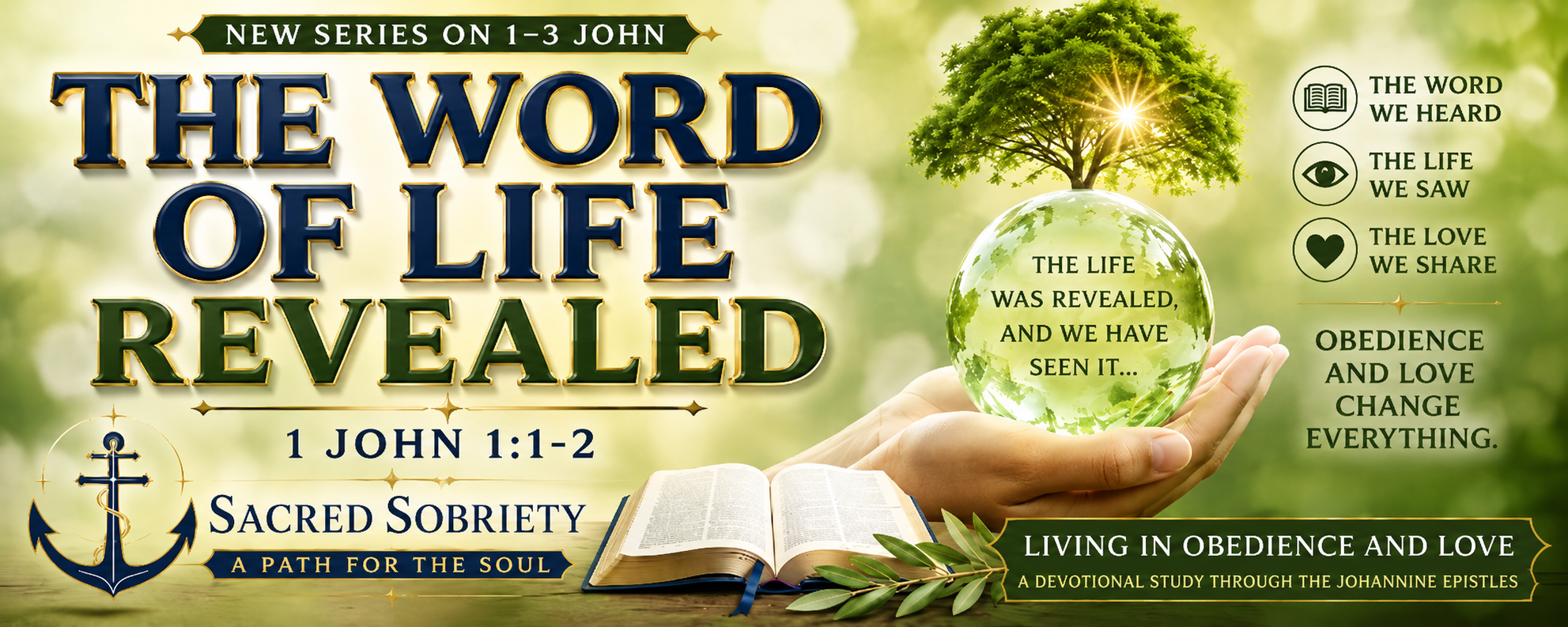
What if life is more than mere survival? Every one of us who has walked through addiction, trauma, grief, broken relationships, or seasons of spiritual drought knows what it feels like to merely exist. We go through the motions. We wake up, move through another day, and sometimes feel as though life is happening to us instead of flowing through us. We learn how to survive the next crisis, manage the next emotion, silence the next craving, or simply make it through another night. Survival may keep us breathing, but deep within us remains the longing to truly live.
What if Jesus Christ—the Word of Life—is inviting us into something more? What if the life we have been desiring, craving, searching for, or attempting to manufacture is not somewhere beyond the horizon? What if the life we genuinely desire has already been revealed in Christ? Not a life without suffering. Not a life untouched by temptation, disappointment, weakness, or grief. Rather, a life anchored in Someone greater than all of those things.
The Apostle John opens his first letter with a declaration that is almost startling in its simplicity. He does not begin with a commandment. He does not begin by telling us what is wrong with the world. He does not begin with a list of spiritual disciplines or a warning about everything we need to change. John begins with Jesus Christ. Before he teaches us about walking in the light, confessing our sins, loving one another, resisting deception, overcoming the world, or keeping ourselves from idols, John establishes the One from whom genuine life flows.
John’s opening declaration is not merely philosophical poetry. It is apostolic testimony. He is essentially saying: We heard Him. We saw Him. We looked upon Him. We touched Him. And the Life we encountered in Jesus Christ is the Life we now proclaim to you. Christ is not presented as an abstract religious idea. He is the living, incarnate revelation of God who entered human history, walked among ordinary people, suffered, died, rose again, and was witnessed by those who followed Him.
This is one of the great truths at the heart of Christian recovery. We do not ultimately heal through concepts, clever slogans, positive thinking, or sheer determination. Those things may have their place, but transformation goes deeper. We are changed as truth moves from something we merely understand into something we actually encounter and live. We learn to trust Christ, walk with Christ, surrender to Christ, and allow His truth to reshape the way we think, respond, relate, and live.
John is not offering speculation. He offers testimony and assurance. The apostles staked their lives upon what they had seen, heard, and experienced in Jesus Christ. And because their testimony points us toward the risen Savior, we are invited to place our recovery, sobriety, identity, relationships, and future upon that same foundation. Christ is not a distant theological idea. He is the Living Word, the Life Revealed, and the faithful revelation of the Father’s heart toward us.
ANCHOR SCRIPTURE
“That which was from the beginning, which we have heard, which we have seen with our eyes, which we have looked upon, and our hands have handled, of the Word of life; (For the life was manifested, and we have seen it, and bear witness, and shew unto you that eternal life, which was with the Father, and was manifested unto us;)”
— 1 John 1:1–2
What does it mean for you today that Jesus Christ declares Himself to be “the way, the truth, and the life” (John 14:6)? Do we comprehend the significance of that declaration in our hearts, minds, and daily lives? And specifically for those of us walking the path of recovery, what does it mean to move beyond simply surviving and begin thriving in a sober-minded, spiritually awakened life?
Jesus Christ - The Word of Life
The Apostle John opens the first of his three letters by bringing us immediately to Jesus Christ. He calls Him the Word of Life. To understand the weight of that expression, it helps to briefly consider the language John uses. The Greek word logos—λόγος—can refer to a word, message, statement, or expression. Within John’s writings, however, the term carries even greater significance. In the opening of his Gospel, John declares, “In the beginning was the Word, and the Word was with God, and the Word was God” (John 1:1). The Word is not merely something God speaks. John presents Jesus Christ as God’s personal and ultimate self-revelation.
The second important word is zōē—ζωή—which simply means life. Throughout John’s writings, this word repeatedly becomes associated with the eternal and spiritual life found in Jesus Christ. John is not merely speaking about biological existence. Everyone who awakens in the morning possesses physical life. Yet it is entirely possible to be physically alive while inwardly exhausted, spiritually numb, emotionally fractured, or enslaved to destructive patterns. John points us toward another dimension of life—a life that originates in God and is revealed through His Son.
This is why Jesus declares, “I am the way, the truth, and the life” (John 14:6). He does not merely claim to offer a philosophy for better living. He identifies Himself as the very source and embodiment of the life we desperately need. The life John encountered in Jesus was not ruled by appetite, fear, ego, resentment, lust, bitterness, or self-preservation. Christ lived in perfect communion with the Father, walked in truth, loved sacrificially, served faithfully, resisted temptation, extended mercy, confronted hypocrisy, and surrendered Himself completely to the will of God.
That is the life into which we are being called. For those of us traveling the road of recovery, the invitation is not simply to stop drinking, stop using, stop acting out, or stop repeating destructive behaviors. Those changes matter deeply, but recovery is ultimately moving us toward something greater. Christ calls us beyond addiction, beyond codependency, beyond toxic relationships, beyond compulsive patterns, beyond resentment, and beyond the identities we constructed while trying to survive. He calls us into a life shaped by truth, obedience, grace, love, humility, and dependence upon God.
This is why the Christian life is often described as a crucified life. Jesus calls His disciples to deny themselves, take up their cross, and follow Him. Paul later expresses that reality when he writes, “I am crucified with Christ: nevertheless I live; yet not I, but Christ liveth in me” (Galatians 2:20). Cruciform living does not mean erasing our personality or becoming spiritually passive. It means allowing the cross of Christ to confront the old patterns that once controlled us so that His character may increasingly shape the life we now live.
That is also the heartbeat of this devotional journey through 1, 2, and 3 John. Over the coming weeks, John will repeatedly confront us with questions of light and darkness, truth and deception, obedience and rebellion, love and hatred, fellowship and isolation, confidence and fear. Yet before John asks us to walk differently, he first points us toward the One who makes a different life possible.
The invitation of this series is therefore simple but profound: move from surviving to thriving, from sobriety to spiritual vitality, from merely avoiding the old life to actually inhabiting the new life Christ has revealed. We are learning to live in obedience and love because the Word of Life has first come near to us.
When Life is Revealed in Christ
The Word of Life From the Beginning: John begins with the phrase, “That which was from the beginning.” Before our story began, Christ was already there. Before the addiction. Before the trauma. Before the betrayal. Before the failures we wish we could erase. Before the wounds we still struggle to understand. Before creation itself, the Son existed in eternal relationship with the Father. John’s Gospel opens with the same reality: “In the beginning was the Word, and the Word was with God, and the Word was God” (John 1:1).
This truth immediately changes the perspective of recovery. We often think our past possesses the greatest authority over our present. We tell ourselves that because something happened to us, because we did something destructive, or because we lived a certain way for many years, our future must remain defined by that history. John points us somewhere deeper. Christ precedes your past. Your wounds are real, but they are not eternal. Your addiction may have shaped years of your story, but addiction does not stand at the beginning of all things. Jesus does.
The Word of Life Made Manifest: John continues, “For the life was manifested.” Something that had been hidden was brought into view. The eternal Son entered human history. John writes in his Gospel, “And the Word was made flesh, and dwelt among us” (John 1:14). God did not remain distant from human suffering. In Jesus Christ, He came near.
This matters for anyone who has ever wondered whether God understands what it feels like to suffer. Jesus knew exhaustion. He knew rejection. He experienced grief. He was betrayed by someone close to Him, abandoned by friends, falsely accused, mocked, beaten, and crucified. Hebrews tells us that we do not have a High Priest who is unable to sympathize with our weaknesses (Hebrews 4:15). The life John proclaims is not detached from the painful realities of human existence. Christ entered them.
The Word of Life Heard: John says, “which we have heard.” The apostles listened to Jesus teach. They heard His parables, His warnings, His promises, His prayers, His rebukes, and His words of mercy. They heard Him speak hope to the broken and truth to the self-righteous. They listened as He declared the kingdom of God and invited people to follow Him.
Recovery also teaches us how desperately we need to learn how to listen again. Addiction trains us to listen to cravings. Trauma may train us to listen continually for danger. Shame teaches us to listen to condemnation. Fear tells us everything that could go wrong. Resentment rehearses everything someone else did to us. Yet discipleship asks another question: Whose voice is shaping the way I live today? The Word of Life invites us to listen again to the voice of Christ.
The Word of Life Seen: John then writes, “which we have seen with our eyes, which we have looked upon.” There is deliberate emphasis here. John wants us to understand that the apostles were not merely repeating a spiritual rumor. They had watched Jesus live. They saw how He responded to sinners, outsiders, grieving families, religious leaders, enemies, children, the sick, and the forgotten. They watched His character under pressure.
This is especially important because recovery requires us to develop a new vision of what healthy life actually looks like. Many of us learned distorted patterns long before we realized they were distorted. Chaos may have felt normal. Manipulation may have looked like love. Control may have masqueraded as care. Avoidance may have felt like peace. Christ gives us a different pattern to behold. The more we look toward Him, the more clearly we begin to recognize which patterns in our own lives reflect His character and which ones do not.
The Word of Life Handled: John goes even further: “our hands have handled, of the Word of life.” The language is strikingly physical. Christianity proclaims an embodied Savior. The eternal Word entered flesh and blood existence. And after the resurrection, Jesus did not appear merely as an idea or memory. Luke records Jesus telling His disciples, “Behold my hands and my feet, that it is I myself: handle me, and see” (Luke 24:39).
John’s emphasis reminds us that faith must eventually become embodied as well. Recovery cannot remain merely inspirational. Sobriety has to enter our schedule, our relationships, our finances, our habits, our conversations, and our reactions. Forgiveness eventually has to affect the way we speak. Integrity must affect what we do when nobody is watching. Prayer has to become something we practice. Boundaries have to become decisions we are willing to maintain. The Word becomes visible in the way we live.
The Word of Life Experienced: John’s repeated language—heard, seen, looked upon, handled—reveals that Christianity is profoundly experiential. This does not mean truth is reduced to emotion or that every spiritual feeling should automatically be trusted. John will later tell us to test the spirits precisely because discernment matters. Yet biblical faith is never intended to remain merely intellectual. We are invited to know Christ personally and walk with Him faithfully.
Many of us discovered the same truth in recovery. We may have known that alcohol was destroying us long before we surrendered it. We may have understood that a relationship was unhealthy while continuing to return to it. Information alone does not guarantee transformation. Change begins as truth becomes practiced reality. We start praying instead of merely believing prayer is useful. We tell the truth instead of merely agreeing that honesty matters. We enter a community instead of merely admitting isolation is harmful. We live what we are learning.
The Word of Life Testified: John says, “we have seen it, and bear witness, and shew unto you that eternal life.” Encounter becomes testimony. John experienced Christ, and now he bears witness so that others may know Him. This pattern runs throughout Scripture. Those who encounter the grace of God frequently become witnesses to what He has done.
This is where our recovery stories begin taking on new meaning. Your testimony is not primarily a celebration of how bad things once became. It is a declaration that brokenness did not have the final word. We do not glorify addiction. We do not romanticize trauma. We do not build an identity around everything we survived. Instead, we testify that God met us there, grace sustained us, truth confronted us, people walked with us, and Christ continues transforming us. Our scars may remain part of our story, but they no longer have to be the title.
The Word of Life Reveals the Father: Finally, John tells us that this eternal life “was with the Father, and was manifested unto us.” Jesus does more than give us information about God. He reveals the Father. Jesus Himself says, “he that hath seen me hath seen the Father” (John 14:9). Through Christ we encounter the holiness, mercy, truth, compassion, justice, patience, and love of God our Father.
Scripture repeatedly speaks of God knowing His people personally. When God called Jeremiah, He declared, “Before I formed thee in the belly I knew thee” (Jeremiah 1:5). The point is not that Jeremiah had somehow earned God’s attention. The passage reveals the depth of divine foreknowledge and purpose. God was not discovering Jeremiah for the first time when Jeremiah finally became useful. His life was already known to God. Likewise, Jesus reminds us that even the hairs of our head are numbered (Matthew 10:30). Our Heavenly Father is not indifferent toward us. He sees, knows, calls, corrects, restores, and draws us toward Himself through His Son.
This is where the Word of Life becomes deeply personal. God does not merely desire that you stop destroying yourself. He desires a relationship with you. He does not merely want improved behavior; He calls you into reconciliation, fellowship, transformation, and life. The Father who knows you also sent His Son so that you might know Him.
From Surviving to Thriving an Abundant Sober Life
Recovery often begins with a moment of revelation. Something becomes impossible to ignore. We finally recognize the damage our behavior is creating, the toll resentment is taking, the relationship pattern we keep repeating, or the painful truth we have spent years avoiding. Jesus said, “ye shall know the truth, and the truth shall make you free” (John 8:32). Freedom begins when we become willing to allow truth into places we previously protected with denial.
Yet Christian recovery moves beyond merely discovering uncomfortable truths about ourselves. Ultimately, truth leads us to Christ. He does not simply expose what is broken; He reveals what life can become. The goal is not endless self-analysis. We do not spend the rest of our lives staring backward at everything that went wrong. Recovery teaches us to remember without returning, examine without condemning ourselves, and move forward with greater wisdom.
John’s emphasis upon hearing, seeing, and touching reminds us that recovery is embodied. We cannot recover only in our thoughts. Healing develops through practices repeated over time. We pray when anxiety rises. We open Scripture when our thinking becomes distorted. We call someone instead of isolating. We attend meetings, enter fellowship, confess what needs to be confessed, apologize when we cause harm, maintain healthy boundaries, and choose honesty when old survival instincts tell us to hide.
Recovery also requires us to examine the voices we continue believing. For many years, addiction may have whispered, You need this to cope. Shame may have whispered, Nobody would love you if they really knew you. Trauma may have whispered, You are never safe. Codependency may have whispered, Your worth depends upon keeping everyone else happy. Christ speaks differently. His words confront deception while simultaneously calling us toward life.
There is also tremendous power in testimony. When someone honestly says, “This is where I was, this is what happened, and this is how God began changing my life,” shame begins losing its monopoly over the story. Revelation 12:11 speaks of overcoming through the blood of the Lamb and the word of testimony. Our stories do not save us—Christ does—but our testimony points toward the Savior who continues redeeming what seemed beyond redemption.
This does not mean every detail of our past needs to become public. Wisdom matters. Boundaries matter. Some experiences belong in confidential conversations with trusted people. Yet secrecy and healthy privacy are not the same thing. Addiction depends upon secrecy because secrecy protects deception. Recovery cultivates honest relationships where we no longer have to maintain an exhausting double life.
For some of us, one of the greatest transitions in recovery occurs when sobriety stops being defined only by what we no longer do. Early recovery may require intense focus upon abstinence, and rightly so. Yet eventually we begin asking a deeper question: What kind of life am I building now? What relationships am I cultivating? What character is being formed? What spiritual practices sustain me? What am I contributing to? Who am I becoming?
This is the invitation of the Word of Life. Sobriety is not merely the absence of a substance or destructive behavior. In Christ, recovery becomes the gradual presence of something new—truth where deception once lived, humility where pride dominated, peace where chaos ruled, healthy connection where isolation flourished, responsibility where blame once prevailed, and love where fear once controlled us.
Learning to Live the Abundant Crucified Life Christ Revealed
Wisdom begins by recognizing that we cannot build a stable life upon unstable desires. Feelings matter, but feelings were never designed to govern us. Cravings rise and fall. Fear exaggerates threats. Anger can distort perception. Loneliness can convince us to return to relationships God may be helping us leave behind. Scripture becomes a lamp precisely because we sometimes need light outside ourselves to show us where the path actually is: “Thy word is a lamp unto my feet, and a light unto my path” (Psalm 119:105).
Grace reminds us that transformation is not sustained by willpower alone. Willingness matters. Discipline matters. Accountability matters. Yet the Christian journey is ultimately dependent upon God’s work within us. Paul writes that it is God who works in us “both to will and to do of his good pleasure” (Philippians 2:13). Grace does not eliminate our participation; grace enables it.
Wisdom also teaches us to become teachable. Recovery becomes dangerous when we begin assuming we have graduated from needing correction. John himself will later warn believers about deception because spiritual maturity does not make us incapable of self-deception. Healthy recovery therefore maintains humility. We continue asking questions. We continue inviting trusted voices into our lives. We continue examining our motives before God.
Grace gives us courage to do that without collapsing into condemnation. Romans 8:1 declares, “There is therefore now no condemnation to them which are in Christ Jesus.” Conviction and condemnation are not the same thing. Conviction says, This needs to change, and Christ is calling you forward. Condemnation says, This is what you are, and you will never change. One leads toward repentance and life. The other drives us toward shame and hiding.
Wisdom helps us understand that recovery usually occurs through ordinary faithfulness rather than constant dramatic breakthroughs. Some days will feel powerful. Other days will feel painfully routine. Yet transformation is often occurring precisely through those repeated acts of obedience: another honest conversation, another morning prayer, another boundary maintained, another temptation surrendered, another day of choosing truth over impulse.
Grace reminds us that stumbling does not require surrender. Scripture never gives us permission to excuse sin or treat destructive behavior casually, but neither does it teach us that spiritual growth is dependent upon flawless performance. First John itself will eventually bring us to Jesus Christ our Advocate. When we fail, we confess. When we fall, we get back up. When we become lost in shame, grace redirects our attention toward Christ.
Wisdom also teaches us that identity shapes behavior. If I continue viewing myself only as an addict, failure, victim, disappointment, or collection of past mistakes, eventually I will begin living according to that identity. The gospel offers something different. Our deepest identity is increasingly rooted in belonging to Christ. John will later marvel, “Behold, what manner of love the Father hath bestowed upon us, that we should be called the sons of God” (1 John 3:1). Recovery flourishes when we begin believing that transformation is actually possible because God is doing more than changing habits—He is forming character.
And grace keeps returning us to the same center: Jesus Christ. The Word of Life revealed is not merely the starting point of Christian recovery. He remains the sustaining center of it. We never graduate beyond dependence upon Him. The deeper we travel into recovery, the more clearly we begin recognizing that thriving is not independence from God. Thriving is learning healthy dependence upon the One who gives life.
L.I.F.E. — The Word of Life Revealed
L — Life Revealed in Christ
Jesus Christ does not merely improve life; He reveals what genuine life is. John declares that “the life was manifested.” Our journey begins by turning toward Christ and allowing Him to redefine what it means to truly live.
When addiction, trauma, fear, or shame has narrowed our world down to survival, Christ expands our vision again. He reminds us that the goal is not merely getting through today. By grace, we are becoming people capable of walking faithfully into tomorrow.
I — Identity Rooted in Christ
Our past explains parts of our story, but it does not possess the authority to define our future. In Christ we discover an identity deeper than our failures, wounds, labels, diagnoses, or mistakes.
Recovery becomes stronger when we stop repeatedly asking, What is wrong with me? and begin prayerfully asking, Who is Christ forming me to become? Identity rooted in Christ gives us a foundation from which healthy change can grow.
F — Faith That Becomes Lived Experience
John heard, saw, looked upon, and touched. His testimony was connected to lived encounter. In the same way, our faith is meant to become something we practice rather than something we merely profess.
Faith begins becoming visible through prayer, integrity, repentance, accountability, forgiveness, healthy boundaries, generosity, service, and daily obedience. The Word of Life begins shaping our way of life.
E — Eternal Life Made Known
John bears witness to “that eternal life, which was with the Father, and was manifested unto us.” Eternal life is not merely a distant future promise. Jesus describes eternal life relationally: “that they might know thee the only true God, and Jesus Christ, whom thou hast sent” (John 17:3).
Recovery therefore points beyond abstinence. Christ brings us into a life increasingly shaped by relationship with God—a life we begin experiencing now and that ultimately finds its fullness in His eternal presence.
Thoughtful Reflection
- Christ existed before the chapter of your life you wish you could rewrite. Your history matters, but it does not possess greater authority than the Savior who stands before it, within it, and beyond it.
- The Word of Life entered real human suffering. Jesus is not distant from weakness, grief, temptation, rejection, or pain. We bring our wounds to someone who entered the realities of human life.
- Recovery must eventually become embodied. Insight is valuable, but truth becomes transformational when it begins shaping our decisions, habits, relationships, and responses.
- Your testimony is not the glorification of your brokenness. It is the witness that brokenness did not have the final word and that Christ continues writing something different through grace.
- God knows you personally. You are not anonymous to your Heavenly Father. Scripture consistently reveals a God who knows, calls, seeks, restores, disciplines, comforts, and loves His people.
- The goal is more than survival. Christ is leading us toward a life increasingly characterized by truth, freedom, healthy relationships, obedience, love, and spiritual vitality.
Questions for Personal Reflection
- Where in my life have I become content with merely surviving instead of asking Christ to teach me how to live?
- Which voice currently has the strongest influence over me—fear, shame, craving, resentment, another person’s approval, or the words of Christ?
- What truth has God recently been revealing that I need to move from understanding into practice?
- What part of my identity am I still allowing my past to define?
- How has Christ already changed my story in ways I may have forgotten to recognize?
- What would one concrete expression of the life of Christ look like in my decisions today?
Receive the Life Christ Revealed
Today, identify one area where you are merely surviving. It may be a thought pattern, a relationship, an unresolved resentment, a temptation, a fear, a habit, or a place where you have simply become emotionally numb.
Do not attempt to solve everything at once. Bring that one area honestly before Jesus Christ. Pray over it. Write about it. Ask what His truth reveals about it. Then choose one concrete act of obedience that moves you toward life.
If isolation has been ruling that area, contact someone safe. If dishonesty has been protecting it, tell the truth. If fear has been controlling it, take the next faithful step. If shame has been defining it, return to what Scripture says about the grace of God. If exhaustion has left you spiritually empty, spend intentional time simply sitting with Christ.
Today’s Challenge
Name one place where you need the life of Christ to replace mere survival—and take one faithful step toward Him today.
You do not have to manufacture the life you need.
The Life you are called to live has already been revealed.
CLOSING PRAYER
Heavenly Father, thank You for revealing Your heart to us through Jesus Christ, the Word of Life. Thank You that Christ is greater than our past, stronger than our addictions, deeper than our wounds, and more faithful than our fears. Teach us to stop merely surviving and begin learning how to live the life You are calling us into.
Also thank you as we hear your voice above the voices of shame, fear, craving, resentment, and self-condemnation. Give us courage to receive Your truth and grace to practice what You reveal. Where we have hidden, bring us into honesty. Where we have become discouraged, renew our hope. Where old patterns continue pulling us backward, strengthen us to walk faithfully forward.
Thank you for the Holy Spirit guiding, comforting, and forming the life of Christ within us. Teach us obedience that grows from trust, love that becomes visible in action, and faith that moves beyond words into the way we actually live. May our recovery become a testimony not to our own strength, but to Your continuing grace.
Father, lead us from mere survival into spiritual vitality. Help us receive the Life You have manifested through Your Son, and teach us to walk faithfully in that Life one day at a time.
In the name of Jesus Christ, amen.
NEXT DEVOTIONAL
Fellowship With God & One Another — 1 John 1:3–4
The Word of Life has been revealed and proclaimed—but John now tells us why: so that we may enter genuine fellowship with one another, with the Son, and with the Father. Tomorrow we will explore why isolation weakens us, why healthy fellowship strengthens recovery, and why the Christian life was never meant to be lived alone.


No comments:
Post a Comment