Friday, September 18, 2026

Antichrists & the Last Hour: Discernment, Recovery, and Standing Firm in Christ


What if one of the greatest threats to your recovery is not the temptation you immediately recognize—but the lie you have slowly learned to tolerate? Recovery is not only a battle against substances, compulsions, destructive behaviors, or old environments. It is also a battle over what we believe. The voice saying, “One time will not hurt.” The voice whispering, “You will always be this way.” The thought insisting, “Nobody understands you, so isolate.” The shame declaring, “After everything you have done, God cannot possibly want you.” Deception rarely announces itself as deception. More often, it sounds reasonable right up until it begins leading us away from life.

That is why John's warning in 1 John 2:18–19 matters so deeply for Christian recovery. John tells his readers that they are living in “the last time” and that “many antichrists” have already appeared. His purpose is not to create panic, obsession, or speculation. John is teaching believers how to recognize voices that oppose the truth about Jesus Christ and how to remain anchored when deception attempts to pull them away.

For those rebuilding life through sobriety, discipleship, and spiritual renewal, this becomes an invitation to develop spiritual discernment. We learn to distinguish truth from counterfeit truth, conviction from condemnation, healthy accountability from shame, godly community from destructive influence, and the voice of Christ from the old voices that once governed our lives.

The Battle Beneath the Battle

Every visible struggle has something happening underneath it. Behind a craving may be loneliness. Behind anger may be fear. Behind isolation may be shame. Behind rationalization may be an old belief we have never challenged. John directs our attention beneath the surface. The deepest battle is ultimately a battle concerning truth: Who is Christ? Whose voice will we trust? What story will define us? And where will we remain when competing voices begin pulling us away?

Learning to Recognize the Counterfeit

A counterfeit succeeds because it resembles something genuine. In the same way, destructive thinking rarely introduces itself by saying, “I am here to destroy your recovery.” Instead, it sounds like relief. It sounds like independence. It sounds like entitlement. It may even sound spiritual. Recovery therefore requires more than avoiding obvious danger. It requires learning to test the voices, thoughts, influences, relationships, and beliefs shaping our decisions.

Christ Has Not Left Us Defenseless

The encouraging truth is that Scripture does not merely warn us about deception and then leave us afraid. God equips His people. John will immediately remind his readers that they possess an anointing from the Holy One and know the truth. Paul tells believers to put on the whole armor of God. Christ teaches His disciples to abide in Him. The Christian life is therefore not a desperate attempt to survive spiritual attack through willpower. It is a life of learning to stand in what Christ has already provided.

Anchor Passage — 1 John 2:18–19

“Little children, it is the last time: and as ye have heard that antichrist shall come, even now are there many antichrists; whereby we know that it is the last time.

They went out from us, but they were not of us; for if they had been of us, they would have continued with us: but they went out, that they might be made manifest that they were not all of us.”

— 1 John 2:18–19, KJV

From Surviving Recovery to Thriving in Sobriety

There is an important difference between surviving recovery and learning to thrive in recovery. Survival says, “I somehow made it through another day.” Thriving begins asking, “What kind of person is Christ forming me into today?” Survival focuses primarily on avoiding the substance, behavior, or destructive pattern. Thriving develops truth, integrity, community, emotional maturity, spiritual discernment, purpose, service, and an increasingly Christ-centered identity.

John's language about remaining becomes especially meaningful here. Recovery is not established through one dramatic decision but through thousands of smaller decisions to remain. We remain honest when secrecy feels easier. We remain connected when isolation feels safer. We remain teachable when pride tells us we already know enough. We remain in prayer when God seems distant. We remain anchored in Christ when shame tells us to run.

And when someone stumbles, struggles, or relapses, 1 John 2:19 should never be weaponized to declare that they were never sincere or that God has discarded them. John's immediate concern is doctrinal departure from the apostolic witness concerning Christ. Recovery application must therefore remain pastoral: a setback exposes something requiring attention, honesty, support, repentance, treatment, accountability, or renewed surrender. It does not give us permission to pronounce final judgment over another person's heart.

Devotional Message — Discernment in the Last Hour

John begins with an unusual urgency: “Little children, it is the last time.” The language is not intended to send believers searching obsessively for dates and timelines. It awakens them to the spiritual seriousness of the age in which they live. The decisive work of Christ has occurred, yet deception remains active. For the recovering believer, that same urgency reminds us that today matters. Recovery cannot forever be postponed until circumstances become easier. Forgiveness cannot endlessly be delayed. Truth cannot continually be negotiated. There comes a moment when we must recognize that spiritual maturity is formed through what we choose today.

John then introduces the disturbing reality of “many antichrists.” Later he explains the heart of the problem: Who is a liar but he that denieth that Jesus is the Christ? He is antichrist, that denieth the Father and the Son (1 John 2:22, KJV). John's language is fundamentally Christological. The issue is not whether someone irritates us, disagrees with us, disappoints us, or leaves our congregation. The spirit of antichrist opposes, distorts, or denies the truth of Jesus Christ. Spiritual discernment therefore begins by keeping Christ—not fear, personalities, controversy, or speculation—at the center.

This matters enormously in Christian recovery because addiction itself flourishes through distortion. It teaches us to call bondage freedom, isolation protection, impulsivity authenticity, intoxication relief, secrecy privacy, and self-destruction comfort. Jesus moves in the opposite direction. He said, If ye continue in my word, then are ye my disciples indeed; And ye shall know the truth, and the truth shall make you free (John 8:31–32, KJV). Notice the connection between continuing and freedom. Truth is not merely something we hear once. We continue in it until it begins reshaping the way we live.

Discernment therefore requires examination. John later writes, Beloved, believe not every spirit, but try the spirits whether they are of God: because many false prophets are gone out into the world (1 John 4:1, KJV). In recovery language, we could say: do not automatically believe every thought simply because it occurred inside your mind. Do not automatically trust every impulse simply because it feels powerful. Do not accept every cultural message about alcohol, drugs, sexuality, money, resentment, pleasure, identity, or success simply because it is repeated frequently. Test what you hear against the character and teaching of Christ.

Paul describes this transformation in Romans 12:2: And be not conformed to this world: but be ye transformed by the renewing of your mind, that ye may prove what is that good, and acceptable, and perfect, will of God. Recovery requires renewed thinking because old behavior is frequently sustained by old beliefs. If the belief remains untouched, the behavior continues looking attractive. Christian sobriety moves deeper than behavioral restraint. Christ begins renovating the thought patterns from which choices emerge.

This is where spiritual warfare becomes practical rather than sensational. Paul writes, Finally, my brethren, be strong in the Lord, and in the power of his might. Put on the whole armour of God, that ye may be able to stand against the wiles of the devil (Ephesians 6:10–11, KJV). Notice where strength originates in the Lord. Recovery becomes exhausting when we attempt to manufacture enough personal strength to guarantee that we will never struggle again. Scripture gives us a different posture. We stand in borrowed strength—the strength of Christ operating through truth, grace, obedience, community, prayer, and continual dependence.

Finally, discernment leads us toward abiding. Jesus said, Abide in me, and I in you. As the branch cannot bear fruit of itself, except it abide in the vine; no more can ye, except ye abide in me. I am the vine, ye are the branches (John 15:4–5, KJV). Recovery is not merely learning how to stop doing something destructive. It is learning where to remain. We remain in Christ. We remain in truth. We remain connected to healthy people. We remain teachable. We remain willing to confess, repair, forgive, learn, and grow. That is how spiritual resilience develops.

Recovery Focus — Recognizing the Voices That Pull Us Away

The path toward relapse often begins long before the substance is consumed or the destructive behavior returns. James describes temptation as a process: But every man is tempted, when he is drawn away of his own lust, and enticed. Then when lust hath conceived, it bringeth forth sin: and sin, when it is finished, bringeth forth death. Do not err, my beloved brethren (James 1:14–16, KJV). That final warning—do not err—is about deception. The recovering person learns to notice the movement before it becomes momentum.

One of the first deceptive voices says, “You are strong enough now that you do not need to be vigilant.” Peter gives the opposite counsel: Be sober, be vigilant; because your adversary the devil, as a roaring lion, walketh about, seeking whom he may devour: Whom resist stedfast in the faith (1 Peter 5:8–9, KJV). Vigilance is not living frightened every day. It is knowing ourselves well enough to recognize vulnerable moments. Hunger, anger, loneliness, exhaustion, resentment, grief, celebration, romantic disappointment, financial pressure, and spiritual discouragement can become openings through which old thinking returns.

Another deceptive voice says, “Do not tell anyone.” Addiction grows exceptionally well in secrecy. Recovery flourishes in truthful connection. Hebrews warns, But exhort one another daily, while it is called To day; lest any of you be hardened through the deceitfulness of sin (Hebrews 3:13, KJV). Notice again the connection between sin and deception. Community helps us see what we cannot always see alone. A sponsor, pastor, mentor, counselor, trusted friend, recovery group, or mature believer may recognize our drift before we recognize it ourselves.

Healthy community also changes how we respond when someone struggles. Paul writes, Brethren, if a man be overtaken in a fault, ye which are spiritual, restore such an one in the spirit of meekness; considering thyself, lest thou also be tempted. Bear ye one another's burdens, and so fulfil the law of Christ (Galatians 6:1–2, KJV). Biblical recovery is not a community standing around waiting to expose failures. It is a community committed to restoration. Accountability without grace becomes punishment. Grace without accountability becomes permission. Christ-centered recovery holds both together.

Discernment also requires the courage to ask God to expose what remains hidden within us. David prayed, Search me, O God, and know my heart: try me, and know my thoughts: And see if there be any wicked way in me, and lead me in the way everlasting (Psalm 139:23–24, KJV). That prayer is dangerous to our denial but life-giving to our recovery. We invite God to reveal resentments we have justified, relationships we have romanticized, compromises we have minimized, wounds we have avoided, and attitudes we have protected.

Yet vigilance should never become hopelessness. Paul assures believers, There hath no temptation taken you but such as is common to man: but God is faithful, who will not suffer you to be tempted above that ye are able; but will with the temptation also make a way to escape, that ye may be able to bear it (1 Corinthians 10:13, KJV). The temptation may be powerful, but it is not sovereign. The craving may scream, but it does not command. The old pattern may feel familiar, but familiarity does not make it destiny. God remains faithful, and recovery teaches us to start looking for the way of escape before the pressure becomes overwhelming.

This is how we move from surviving sobriety toward thriving in recovery. We stop asking only, “How do I avoid using today?” and begin asking, “How do I live truthfully today? How do I strengthen connection today? How do I serve today? How do I recognize Christ's presence today? What lie needs to be challenged today?” Hebrews says, And let us consider one another to provoke unto love and to good works: Not forsaking the assembling of ourselves together... but exhorting one another (Hebrews 10:24–25, KJV). Thriving recovery becomes a life that is increasingly connected, purposeful, truthful, loving, and rooted in Christ.

Wisdom and Grace — Putting on the Armor of God in Recovery

Paul's instructions in Ephesians 6 give us a powerful picture for putting discernment into practice. He says, Wherefore take unto you the whole armour of God, that ye may be able to withstand in the evil day, and having done all, to stand (Ephesians 6:13, KJV). The repeated emphasis is standing. There will be days when recovery feels like tremendous forward progress. Other days, victory may simply mean that you refused to abandon your position. You called someone instead of isolating. You prayed instead of escaping. You told the truth instead of hiding. You went to bed sober. Sometimes standing is the miracle.

The first piece is truth: Stand therefore, having your loins girt about with truth (Ephesians 6:14, KJV). In recovery, truth means radical honesty. I cannot heal what I continue pretending does not exist. Truth says, “I am struggling.” Truth says, “That relationship is dangerous for me.” Truth says, “I am resentful.” Truth says, “I am thinking about using.” Truth says, “I need help.” The belt of truth holds everything else together because deception begins losing power the moment it is dragged into the light.

Paul continues, and having on the breastplate of righteousness (Ephesians 6:14, KJV). Righteousness is not self-righteous perfection. For the recovering disciple, it becomes integrity lived one decision at a time. We make the next faithful choice even when nobody is watching. We keep commitments. We repair harm. We practice boundaries. We become dependable. Grace does not merely forgive yesterday; grace trains us to live differently today.

Then come the shoes: And your feet shod with the preparation of the gospel of peace (Ephesians 6:15, KJV). Recovery eventually requires movement. We cannot spend our entire lives staring backward at everything addiction destroyed. The gospel gives us peace with God and a new direction for life. We begin walking toward reconciliation, service, healthy relationships, meaningful work, spiritual growth, and purpose. The recovering soul begins to realize, “God did not rescue me merely so that I could spend the rest of my life terrified of returning to the past. He is teaching me how to walk forward.”

Paul then says, Above all, taking the shield of faith, wherewith ye shall be able to quench all the fiery darts of the wicked (Ephesians 6:16, KJV). Some fiery darts sound like accusation: “You are still the person you used to be.” Others sound like despair: “Nothing has really changed.” Others sound like entitlement: “After everything you have endured, you deserve this.” Faith raises the shield and answers: “My feelings are real, but they are not my final authority. Christ is faithful. Grace is real. Transformation is possible. I do not have to obey this thought.”

Next Paul tells us, And take the helmet of salvation (Ephesians 6:17, KJV). The helmet guard's identity. Recovery becomes much stronger when we stop building identity around what once enslaved us. There is an important place for saying, “I am in recovery,” because humility remembers vulnerability. But the gospel speaks an even deeper word over us: we belong to Christ. Our past may explain parts of our story, but it does not possess naming rights over our future. Salvation reminds us of whose we are before temptation tells us who we used to be.

Finally comes the sword of the Spirit, which is the word of God followed immediately by Paul's call to be praying always with all prayer and supplication in the Spirit, and watching thereunto with all perseverance (Ephesians 6:17–18, KJV). Scripture gives us language with which to confront lies, while prayer keeps us consciously dependent upon God. We do not wield Scripture to attack hurting people. We allow Scripture to cut through deception within ourselves. We pray before the crisis, during the craving, after the victory, through the grief, in the temptation, and within the ordinary rhythms of everyday life. That is wisdom joined with grace.

A.R.M.O.U.R. — A Recovery Framework for Last-Hour Discernment

The whole armor of God gives us more than an inspiring image. It gives us a practical framework for Christian sobriety. When confusion increases, temptation rises, old thinking returns, or spiritual opposition feels intense, remember A.R.M.O.U.R.

A — Anchor Yourself in Truth

Begin with the belt of truth. Ask what is actually true rather than what the craving, fear, resentment, shame, or impulse is telling you. Honesty interrupts deception. Tell God the truth. Tell yourself the truth. Tell a safe person the truth. Jesus connects continuing in His Word with knowing truth and experiencing freedom. Recovery becomes stronger whenever secrecy loses another place to hide.

R — Reinforce Your Heart with Righteousness

The breastplate of righteousness reminds us to protect the heart through integrity. We cannot control every thought, feeling, temptation, or circumstance, but we can practice faithful responses. Make the next right decision. Keep the boundary. Attend the meeting. Make the call. Apologize when necessary. Walk away when necessary. Delete the number. Change the route. Keep your commitment. Repeated acts of integrity build spiritual resilience.

M — Move Forward in the Gospel of Peace

Recovery is not meant to leave us permanently standing at the scene of our worst mistakes. The gospel gives our feet somewhere new to go. Move toward peace rather than chaos, reconciliation rather than resentment, community rather than isolation, service rather than self-absorption, and Christ rather than the counterfeit promises that once controlled you. Sobriety creates space for a life worth living.

O — Overcome Accusation with Faith

The shield of faith does not pretend that consequences, struggles, cravings, or painful memories are imaginary. Faith places them beneath a greater reality: God remains faithful. When accusation says, “You will never change,” faith remembers that transformation is often slow but real. When temptation says, “You cannot survive this feeling,” faith remembers previous moments God has carried you through. When shame says, “Hide,” faith moves toward grace.

U — Understand Your Identity in Salvation

The helmet protects the mind because identity influences behavior. If you continually see yourself only as ruined, rejected, dirty, hopeless, or defined by yesterday, you will eventually begin living according to that identity. Salvation tells another story. You are someone Christ calls to follow Him. You are someone grace can teach. You are someone who can repent, repair, mature, serve, love, grow, and become useful in the lives of others. Recovery is part of your story; it does not have to be the boundary of your identity.

R — Respond with the Word and Prayer

Take up the sword of the Spirit and remain in prayer. When a lie appears, answer it with truth. When temptation rises, pray before negotiating with it. When shame resurfaces, return to the promises of God. When loneliness becomes dangerous, pray and reach outward. When you do not know what to do next, stay close to Scripture until the next faithful step becomes clear. God's Word and prayer are not magical formulas; they cultivate the ongoing relationship with Christ from which discernment and perseverance grow.

Thoughtful Reflection — What Voice Am I Following?

Where have I recently been tempted to minimize something, I know threatens my spiritual health or recovery? Consider the places where you have begun bargaining with boundaries you once recognized as necessary.

What lie becomes most believable when I am tired, lonely, angry, ashamed, discouraged, or overwhelmed? Naming the lie makes it easier to prepare a truthful response before the vulnerable moment arrives.

Am I moving toward community or slowly withdrawing from it? Isolation frequently develops gradually. Consider whether you have stopped answering calls, attending meetings, praying with others, participating in fellowship, or speaking honestly about what you are experiencing.

Which piece of God's armor feels weakest in my life right now? Do you need deeper honesty, greater integrity, peace, renewed faith, stronger identity in Christ, more time in Scripture, or more consistent prayer?

What would thriving rather than merely surviving look like during the next twenty-four hours? Do not attempt to solve the rest of your life tonight. Identify the next faithful action and take it.

The Challenge — Stand Today

You do not need to win tomorrow's battle tonight. You need to stand faithfully in the moment God has placed in front of you. Put on the armor. Tell the truth. Guard your heart. Walk in peace. Raise the shield of faith. Remember whose you are. Take God's Word seriously. Pray. Stay connected. And when you discover that you have drifted, turn toward Christ instead of running farther away.

The last hour is not a summons to panic. It is a summons to discernment. John reminds us that deception is real, but he also reminds us that truth is knowable. Paul reminds us that conflict is real, but the armor has already been provided. Jesus reminds us that apart from Him we can do nothing, but when we abide in Him our lives can bear fruit.

That is the movement of Sacred Sobriety: from secrecy into truth, from isolation into fellowship, from shame into grace, from merely surviving temptation into learning how to thrive in Christ.

Today, stand.

Tomorrow, stand again.

And when the counterfeit voice tells you that freedom is found somewhere outside the truth, remember the One who said that truth makes us free.

Closing Prayer

Father, give me discernment to recognize the voices that lead me away from truth. Expose the lies I have tolerated, the compromises I have minimized, and the places where I have begun depending upon myself instead of You. Teach me to put on the whole armor of God—to walk in truth, righteousness, peace, faith, salvation, Your Word, and prayer. When temptation comes, help me stand. When shame speaks, remind me who I am in Christ. When I become isolated, give me courage to reach toward healthy community. When I stumble, lead me back toward grace rather than deeper into hiding. Teach me not merely to survive recovery but to thrive in the life You are rebuilding within me. Keep me anchored in Christ, disciplined in grace and faith, and faithful in the truth. In Jesus' name, Amen.


Sacred Sobriety: A Path for the Soul
Anchored in Christ | Thriving in Sobriety


Thursday, September 17, 2026

The World Passes Away | 1 John 2:17 Devotional | Eternal Perspective, Recovery, and New Life in Christ


There are moments in life when the world feels like it’s ending, even when it’s something as small as a forgotten soda at a bus stop. I remember standing with my daughter when she was just a toddler, watching her face crumple as she realized her drink had been left behind. I tried to soothe her, telling her gently that it wasn’t the end of the world. She insisted that it was. After a few rounds of back‑and‑forth, I finally asked her what she meant. In her innocent, catastrophic thinking, she explained that when she dies, it will be the end of the world for her. I had to stifle a laugh, not at her fear, but at the purity of her logic. In her little mind, the world ends when her experience of it ends. And in a way, she wasn’t wrong. When our time comes, the world as we know it does come to an end.

That moment has stayed with me because it mirrors something many of us experience when we come into faith or recovery. When addiction breaks, when codependency loosens its grip, when fear is confronted, when a faith crisis resolves, when grace finally breaks through—our old world passes away. The life we once knew ends. The worldview we once carried dissolves. The identity we once clung to fades. And in its place, God gives us a new perspective, a new way of living, and a new world to inhabit. This is the heart of 1 John 2:17, and it flows directly from John’s warning in the previous verses: the world and its desires are fading, but those who do the will of God abide forever.

John’s words are not meant to frighten us but to free us. When he says the world is passing away, he is not speaking of creation itself but of the systems, desires, and attachments that pull us away from God. He is reminding us that everything we cling to outside of Christ is temporary. Everything we chase apart from Him is fading. Everything we trust in that is not rooted in His will is already dissolving beneath our feet.

This devotional continues the journey we began in 1 John 2:15–16, where John exposed the lust of the flesh, the lust of the eyes, and the pride of life. Now he shows us their destiny. They do not endure. They cannot sustain. They will not last. But those who do the will of God—those who surrender, obey, trust, and walk in grace—step into something eternal. Something unshakeable. Something that does not pass away.

Anchor Verse: “The world and its desires pass away, but whoever does the will of God lives forever.” (1 John 2:17)

John’s contrast is sharp and intentional. The world fades. The will of God endures. Our old life dissolves. Our new life in Christ remains. This is not merely theology; it is the lived experience of every believer who has watched their old-world crumble so that a new one could be born. It is the story of recovery, redemption, and rebirth. It is the story of grace.

Tuesday, September 15, 2026

Do Not Love the World: Freedom from Attachment | 1 John 2:15–16


There are things we possess, and then there are things that begin to possess us. A desire may begin innocently. A preference may simply be something we enjoy. An achievement may represent years of legitimate effort. Yet somewhere along the journey, what we enjoy can become what we need, what we need can become how we define ourselves, and what defines us can eventually begin competing with God for the allegiance of our hearts.

That is why John’s words are intentionally uncomfortable: “Love not the world, neither the things that are in the world” (1 John 2:15). John is not teaching that trees, music, friendship, creativity, work, food, possessions, recreation, or human relationships are inherently evil. Scripture begins by declaring God’s creation good. The issue is not creation itself. The issue is the fallen system of desires, values, appetites, ambitions, and identities that trains the human heart to seek apart from God what can ultimately be found only in Him.

This becomes especially significant in recovery. Addiction rarely begins with someone consciously deciding to surrender his or her life to bondage. More often, something initially offers relief, pleasure, security, belonging, escape, validation, or control. Eventually, however, the relationship changes. We no longer simply possess the substance, behavior, relationship, achievement, resentment, or identity. It begins possessing us.

John therefore invites us to examine more than behavior. He directs us toward the affections of the heart. Recovery is not merely asking, “What must I stop doing?” Spiritual maturity asks the deeper question: “What has my heart learned to love, trust, pursue, or depend upon more than God?”

Anchor Verse

“For all that is in the world, the lust of the flesh, and the lust of the eyes, and the pride of life, is not of the Father, but is of the world.”
1 John 2:16

John identifies three powerful channels through which disordered attachment operates: the lust of the flesh, the lust of the eyes, and the pride of life. One reaches through appetite, another through acquisition and comparison, and another through identity, status, and self-exaltation. Together they describe much of the battlefield on which modern discipleship and recovery are fought.

The good news is that John does not expose these competing loves merely to condemn us. He exposes them because Christ intends to make us free. When grace rearranges what we love, we discover that freedom is not having everything we desire. Freedom is reaching the place where temporary things no longer control who we believe ourselves to be.

Monday, September 14, 2026

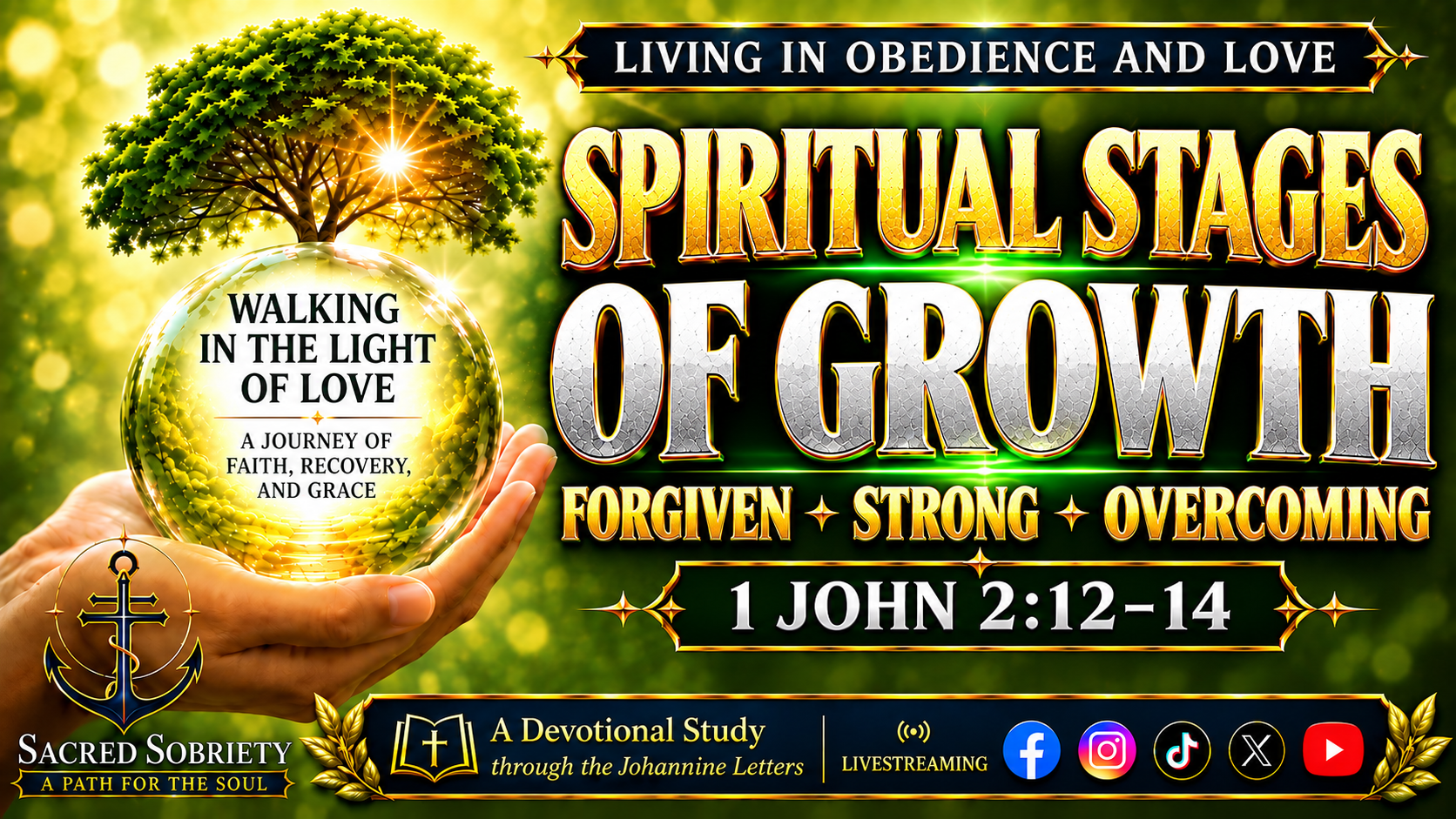
Spiritual Stages of Growth: 1 John 2:12-14 Devotional

Spiritual Stages of Growth: 1 John 2:12-14 Devotional

What if spiritual maturity is not measured by how little you struggle, but by what now abides within you when the struggle comes? John writes to little children, fathers, and young men, reminding them that they are forgiven, that they know the Father, that the Word of God abides in them, and that they have overcome the wicked one. This is not simply a description of where believers are. It is a picture of what grace is progressively forming us to become.

For those of us walking the path of recovery and sobriety, this matters deeply. We are not merely trying to survive another day without returning to old patterns. We are learning how to become men and women whose lives increasingly reflect the character, faithfulness, strength, and love of the God who redeemed us.

Forgiven, Growing, and Overcoming

“I write unto you, little children, because your sins are forgiven you for his name’s sake. I write unto you, fathers, because ye have known him that is from the beginning. I write unto you, young men, because ye have overcome the wicked one.” — 1 John 2:12–13, KJV

There are moments in our journey when we wonder whether we have actually grown. We remember where we have been, what we have done, relationships that remain fractured, opportunities we lost, people we disappointed, and consequences that cannot simply be erased. Recovery may have given us distance from the destructive behaviors of our past, yet certain wounds still follow us into the present. Shame has a way of pointing backward and saying, “Look at all the evidence that you failed.”

John points us somewhere else. He begins with forgiveness: “Your sins are forgiven you for his name’s sake.” Before John talks about strength, overcoming, maturity, spiritual warfare, or knowing God deeply, he begins with grace. Our spiritual development does not begin with proving ourselves worthy of God. It begins with recognizing what God has already accomplished through Jesus Christ.

The phrase “for his name’s sake” carries extraordinary weight. In Scripture, a name represents more than a label. It speaks of character, authority, reputation, purpose, and covenant faithfulness. When John says our sins are forgiven for His name’s sake, he directs our attention away from our ability to compensate for our failures and toward the character and redemptive work of Christ.

The Psalmist uses similar covenantal language when he declares, “He restoreth my soul: he leadeth me in the paths of righteousness for his name’s sake” (Psalm 23:3). God restores because restoration reveals who He is. His mercy does not diminish His holiness, and His justice does not extinguish His compassion. Redemption demonstrates the glory of a God who remains faithful to His promises even when fallen humanity desperately needs rescuing.

This is where recovery becomes more than behavior modification. Through Christ we are invited into genuine fellowship with our Heavenly Father, and through that fellowship we begin learning how to live differently with one another. John has been developing this theme from the beginning of his letter: fellowship with the Father, fellowship with the Son, walking in the light, confessing our sins, receiving cleansing, and learning obedience through love. Spiritual growth develops within that covenantal relationship.

John therefore speaks to his readers with familial language: children, fathers, and young men. We should be cautious about turning these expressions into a rigid spiritual ranking system. “Little children” is one of John’s affectionate ways of addressing believers generally, while fathers and young men may also represent differing degrees of spiritual experience and strength. Yet the progression offers us a powerful devotional picture: we receive forgiveness, come to know our Father, become strengthened by the Word, learn to overcome what once mastered us, and eventually become capable of strengthening others.

That progression speaks directly to recovery. We do not remain forever at the place where our testimony is simply, “I stopped doing what was destroying me.” Grace calls us farther. We learn to say, “I know my Father. His Word abides in me. What once controlled me no longer possesses the authority it once had. I am becoming strong enough to walk beside another traveler.” That is the movement from merely surviving sobriety toward actually thriving in spiritual life.

Friday, September 11, 2026

The Commandment of Love: Walking in the Light — 1 John 2:7–11

The Commandment of Love: Walking in the Light — 1 John 2:7–11

Living in Obedience and Love

A Devotional Study through the Johannine Letters - Sacred Sobriety: A Path for the Soul


What If Our Understanding of Love Has Become Distorted?

What if some of what we have called love was never really love at all? What if it was fear of abandonment, approval seeking, rescuing, control, emotional dependence, obligation, or the desperate hope that if we gave enough of ourselves someone would finally choose us, appreciate us, or stay? Many of us enter recovery discovering that our understanding of love has been shaped as much by wounded relationships as it has been by Scripture.

This becomes especially complicated when we have been hurt by people we genuinely loved. Betrayal can teach us to protect ourselves through anger, disappointment can harden into resentment, and repeated mistreatment can convince us that loving another person means either allowing them unrestricted access to our lives or cutting them completely out of our hearts. Somewhere between those extremes, Christ invites us to discover a love that is neither weak nor transactional but spiritually transformational.

An Old Commandment Made New in Christ

John now continues the thought he began in 1 John 2:3–6. He has just told us that those who say they abide in Christ ought to “walk, even as he walked” (1 John 2:6). The immediate question therefore becomes unavoidable: What does walking as Jesus walked actually look like when another human being disappoints us, irritates us, betrays us, disagrees with us, or wounds us?

John answers by bringing us back to the commandment of love. It is an old commandment because God’s people had long been taught to love their neighbor, yet John can also call it new because Jesus embodied that commandment with a depth, sacrifice, mercy, and holiness that brought it into unmistakable clarity. Jesus did not merely explain love; He demonstrated what divine love looks like when it enters a wounded world.

Love Does Not Require Denial, Enabling, or Self-Erasure

For those of us walking through recovery, this passage must be handled with both truth and grace. John is not commanding us to pretend abuse never happened, overlook destructive behavior, immediately restore broken trust, abandon healthy boundaries, or place ourselves back into unsafe situations. Christlike love is not the surrender of wisdom, discernment, accountability, or personal responsibility.

John is addressing something deeper: what happens inside our hearts when injury becomes hatred, bitterness becomes identity, and resentment becomes the lens through which we interpret everything around us. We may physically escape a destructive situation while remaining emotionally imprisoned by it. The person who harmed us may no longer be present, yet the injury continues directing our thoughts, reactions, relationships, and spiritual life.

Anchor Passage — 1 John 2:7–11: “Brethren, I write no new commandment unto you, but an old commandment which ye had from the beginning. The old commandment is the word which ye have heard from the beginning. Again, a new commandment I write unto you, which thing is true in him and in you: because the darkness is past, and the true light now shineth. He that saith he is in the light, and hateth his brother, is in darkness even until now. He that loveth his brother abideth in the light, and there is none occasion of stumbling in him. But he that hateth his brother is in darkness, and walketh in darkness, and knoweth not whither he goeth, because that darkness hath blinded his eyes.

John places love directly beside the imagery of light and darkness because love reveals something about our spiritual condition. The question is not whether we have ever felt anger, experienced relational pain, needed distance, or struggled to forgive. The deeper question is whether we are allowing Christ to transform what those wounds are producing within us. Continue with me as we explore how love, resentment, forgiveness, boundaries, recovery, and spiritual sight all converge in John’s command to walk in the light.

Thursday, September 10, 2026

Knowing God Through Obedience: Walking as Jesus Walked - 1 John 2:3-6

Knowing God Through Obedience: Walking as Jesus Walked - 1 John 2:3-6

Living in Obedience and Love

Sacred Sobriety: A Path for the Soul


When Loving God Feels Difficult

“And hereby we do know that we know him, if we keep his commandments.”
— 1 John 2:3 KJV

How do I love God when there have been seasons when I genuinely felt abandoned by Him? How do I learn to trust God when experience has taught me that depending upon someone else eventually leads to disappointment, betrayal, exhaustion, or being left alone? These are difficult questions, but they are also deeply human questions that many people walking through recovery carry quietly beneath the surface of their faith.

For some of us, learning to survive meant becoming fiercely independent because depending upon other people rarely seemed safe. We learned how to anticipate problems before they happened, keep everyone around us calm, meet other people's needs, suppress our own emotions, and somehow keep moving even when we were falling apart internally. What looked like strength from the outside was often a survival strategy developed in environments where vulnerability seemed dangerous.

Others learned that love meant giving until we were completely drained. We became the rescuer, the fixer, the peacemaker, the person who answered the late-night phone call, covered another person's consequences, loaned the money, absorbed the emotional chaos, and continually placed ourselves last. Eventually we began wondering why love always seemed to demand that we disappear.

These experiences inevitably influence the way we understand God. If people who claimed to love us repeatedly disappointed us, we may wonder whether God will ultimately do the same. If authority figures were harsh or controlling, commandments may sound less like loving guidance and more like another demand being placed upon us.

This is why John's words in 1 John 2:3–6 cannot be reduced to a simple command to behave better. John is describing what happens when fellowship with God becomes genuine enough to begin reshaping our lives. Knowing God moves from information into relationship, and relationship gradually begins changing how we think, respond, love, forgive, establish boundaries, surrender, and live.

For those walking a path of recovery, this passage speaks directly to the movement from surviving toward thriving. God is not merely asking us to stop doing destructive things; He is teaching us how to live differently because we are learning who He is, who we are in relationship with Him, and what healthy love actually looks like. Obedience therefore becomes less about religious performance and more about learning to walk with Christ one faithful step at a time.

Wednesday, September 9, 2026

Christ Our Advocate Before the Father | Grace for the Struggle, Strength for the Journey - 1 John 2:1-2

Christ Our Advocate Before the Father | Grace for the Struggle, Strength for the Journey - 1 John 2:1-2

Living in Obedience and Love

A Devotional Study through the Johannine Letters

Sacred Sobriety: A Path for the Soul


“My little children, these things write I unto you, that ye sin not. And if any man sin, we have an advocate with the Father, Jesus Christ the righteous: And he is the propitiation for our sins: and not for ours only, but also for the sins of the whole world.” — 1 John 2:1–2


What Happens When We Struggle Again?

What happens when we know what is right, genuinely desire what is right, have prayed for strength to do what is right, and still find ourselves struggling? What happens when an old temptation resurfaces, when resentment begins gaining ground, when codependent behavior returns, when fear starts dictating our decisions, or when a moment of spiritual uncertainty causes us to question whether our faith is as strong as we thought it was? For those of us walking a path of recovery and sobriety, these moments can feel especially unsettling because they remind us that progress does not eliminate vulnerability.

Our immediate response is often shame. We tell ourselves that we should know better, should be stronger, should have progressed farther, or should no longer experience the thoughts, cravings, fears, doubts, or relational tendencies that once controlled us. Before long, a temporary struggle becomes an indictment against our entire identity, and instead of seeing ourselves as people growing in grace, we begin seeing ourselves only through the lens of our weakness.

John offers us another way. He does not minimize sin, excuse destructive behavior, or suggest that grace makes obedience unnecessary. He writes plainly, “These things write I unto you, that ye sin not.” The direction of Christian discipleship is toward holiness, truth, obedience, love, and increasing conformity to Jesus Christ. Yet John immediately follows this exhortation with hope: “And if any man sin, we have an advocate with the Father, Jesus Christ the righteous.”

Failure does not have the final word because Christ does. The gospel does not teach us to deny our weakness, nor does it command us to live beneath perpetual condemnation. Instead, it invites us to acknowledge our need, walk into the light, confess honestly, receive grace, and continue moving forward with Christ.

Recovery Between Temptation and Grace

First John becomes remarkably practical when we place it alongside the realities of addiction recovery, codependency, trauma, dysfunctional family systems, temptation, spiritual uncertainty, and the daily discipline of sobriety. Recovery is not simply learning how to stop drinking, using, escaping, controlling people, seeking constant validation, or repeating destructive relational patterns. Recovery eventually becomes the transformation of how we understand God, ourselves, our weaknesses, our responsibilities, and the grace that enables us to become different people.

John has already told us that Jesus Christ is the Word of Life. He has invited us into fellowship with the Father, fellowship with Christ, and fellowship with one another. He has reminded us that God is light and that genuine fellowship with Him means stepping out of darkness rather than hiding within it. When sin becomes visible in that light, we are not instructed to deny it or pretend it does not matter. We confess it because God is faithful and just to forgive us and cleanse us from all unrighteousness.

Now John answers the question that naturally follows: What happens when someone who sincerely desires to walk in the light still stumbles? His answer is not despair, rejection, or permanent condemnation. His answer is that we have an Advocate with the Father.

That truth changes the way we understand recovery. We are not required to manufacture enough righteousness to compensate for yesterday’s weakness, defend ourselves before God, or somehow persuade Him that we remain worthy of His attention. Jesus Christ the righteous stands with us before the Father, and His advocacy rests upon His righteousness rather than our ability to construct a defense for ourselves.

“My Little Children”

John begins this passage with remarkable tenderness: “My little children.” He is not insulting the believers or suggesting that they remain spiritually immature. He is addressing them as members of a spiritual family, speaking with pastoral affection and reminding them of their relationship with God and with one another.

This image carries significant meaning for those of us in recovery. Many people learned early in life that weakness was dangerous, vulnerability invited rejection, emotions needed to be hidden, and personal safety required controlling circumstances or anticipating the moods of others. Some developed patterns of people pleasing, emotional withdrawal, substance use, perfectionism, caretaking, hyper-independence, or codependency because those behaviors once helped them survive environments that felt unpredictable or unsafe.

Jesus calls us toward a very different posture. Except ye be converted, and become as little children, ye shall not enter into the kingdom of heaven.” — Matthew 18:3

Becoming like a little child does not mean becoming childish, irresponsible, naïve, or incapable of mature thought. It means relinquishing the illusion of complete self-sufficiency and learning to trust the Father. It means cultivating humility, teachability, dependence, honesty, and the willingness to receive what God provides rather than constantly attempting to save ourselves.

Recovery eventually brings us to the uncomfortable but liberating realization that self-sufficiency cannot heal us. We need relationship, community, truth, accountability, grace, and ultimately a Father whose love is not controlled by our performance. We need an Advocate who knows both our weaknesses and the way home.

Anchor Verse - And if any man sin, we have an advocate with the Father, Jesus Christ the righteous.” — 1 John 2:1

John does not tell us that we might someday obtain an Advocate if we become sufficiently worthy. He says that we have an Advocate. Christ’s ministry toward us rests upon who He is—Jesus Christ the righteous—rather than upon our ability to defend our record.

Shame asks, How are you going to explain yourself this time? Grace answers by directing us away from self-defense and toward Christ. We still take responsibility, confess honestly, make appropriate amends, and continue growing, but we no longer have to believe that our worst moment possesses authority to define our entire identity.

Therefore, First John 2:1–2 brings us into one of the most reassuring realities of Christian discipleship. When we stumble, face temptation, wrestle with addiction, experience a crisis of faith, struggle with codependency, or confront the consequences of our own choices, Jesus Christ does not abandon us. He stands as our Advocate before the Father, calling us away from condemnation and toward confession, reconciliation, transformation, and restored fellowship.

John’s description of believers as “little children” also reminds us that spiritual maturity does not mean becoming independent from God. It means developing an increasingly trusting dependence upon Him. For those walking a path of recovery and sobriety, this passage invites us to exchange accusation for advocacy, shame for honesty, isolation for fellowship, and self-sufficiency for a relationship with the Father through Jesus Christ.

About Me

My photo
Timothy R. Berman is a Christian devoted to living a mindful, crucified life—one shaped by surrender, spiritual attentiveness, and the pursuit of divine wisdom. Passionate about unveiling God‑breathed insights, he writes soul‑stirring devotionals that guide readers into deeper faith, renewed identity, and Christ‑centered transformation. Timothy’s work invites believers to slow down, reflect, and encounter God in ways that strengthen their walk and enrich their relationship with Him.