Set the Sail for Recovery | The Making of a Man: Think, Worship, and Work
Listen, sobriety does not automatically make a man godly. A man may stop drinking, using, or acting out and still remain mentally undisciplined, spiritually disconnected, emotionally immature, and unwilling to take responsibility for his life. Abstinence may remove the substance, but it does not automatically restore the soul. Sobriety may clear the fog, but only God can reshape the man. That is why A. W. Tozer’s words in “The Making of a Man” strike with such force: humanity was created to think, to worship, and to work.
Abstinence matters, and separating ourselves from destructive substances and behaviors is often the necessary beginning of recovery. Yet recovery must eventually become about more than what we have stopped doing; it must also include who we are becoming. What kind of man am I becoming? What does godliness look like in everyday life? What does it mean to become a man after God’s own heart? This is not about bravado, domination, emotional detachment, or religious performance. It is about becoming the kind of man Christ shapes—one whose mind is renewed, whose heart is awakened, and whose hands are committed to faithful and meaningful labor.
Anchor Verse:2 Thessalonians 3:10 - “For even when we were with you, we gave you this command: anyone unwilling to work should not eat.”
Paul’s words are direct, but they are not aimed at those who are weak, struggling, sick, or legitimately unable to work. He is confronting deliberate idleness, avoidance, and an unwillingness to take responsibility or participate in the life of the community. Those of us in recovery understand this tension. Some want sobriety without transformation, freedom without discipline, or healing without surrender. Genuine compassion does not enable the patterns that keep us trapped; it encourages responsibility, accountability, spiritual maturity, and faithful participation in life.
This is where Tozer’s framework becomes especially meaningful. To think is to develop a disciplined and truth-seeking mind submitted to Christ. To worship is to live in conscious communion with God and allow His Spirit to awaken the deepest parts of our being. To work is to engage our gifts, relationships, responsibilities, and calling with integrity and perseverance. These three pillars—thinking, worshiping, and working—provide the foundation for moving beyond abstinence into spiritual wholeness and Christlike maturity. As we enter this devotional message, we will explore how God uses each of them to shape sober men—and every person walking the recovery journey—into people of purpose, integrity, and spiritual strength.
Although this message speaks directly to men, its central applications reach every person walking through addiction recovery, anxiety, fear, doubt, spiritual confusion, unresolved pain, and the many hurts and hang-ups that complicate our lives.
How does all of this connect with Tozer’s observation?
Simply stated, humanity was created to think, to worship, and to work. These three pillars help form what it means to become whole, restored, and complete in Christ. They also support the kind of vibrant and abundant life in which we do more than remain sober—we begin to thrive through our faithful participation in the recovery process.
- To think means more than having opinions. It means becoming a disciplined, imaginative, and truth-seeking person whose mind is submitted to Christ.
- To worship means more than singing songs or attending a weekly service. It means living in conscious communion with God and allowing His Spirit to awaken the deepest parts of our being.
- To work means more than holding a job. It means engaging our hands, gifts, responsibilities, relationships, and calling with integrity, purpose, and perseverance.
Tozer writes that a man may be educated, talented, or intellectually brilliant and still remain “unformed and rudimentary” until he becomes a worshiper. Even then, he is not complete until he becomes a worker—a man who invests his whole personality in meaningful, creative, and sacrificial labor for the glory of God.
Such a man seeks first the kingdom of God and His righteousness, trusting God with the promised blessings that follow faithful discipleship (Matthew 6:33). His labor becomes consecrated to God as he walks in obedience, sacrifice, fidelity, chastity, and devotion to the gospel of Jesus Christ. These principles ultimately point us toward what Paul calls fulfilling “the law of Christ” by bearing one another’s burdens (Galatians 6:2). In other words, we walk in covenant loyalty by loving God and loving one another.
This is the making of a man. It is the restoration of God’s image within our hearts, minds, and spirits. It is the path of recovery that leads us beyond abstinence and into spiritual wholeness, maturity, and Christlike character.
Today, we are going to explore how these three pillars—thinking, worshiping, and working—shape a sober man into a godly man. We will do so through Paul’s counsel in 2 Thessalonians 3:6–14, Tozer’s insights, and the lived reality of recovery.
So, buckle up, buttercup. This message may convict you. It may inspire you. It will certainly challenge you to examine your life with honesty and hope. God is shaping you right now into a person of purpose, integrity, and spiritual strength. And yes, that includes the women among us as well.
Devotional Message
Tozer begins with the mind because genuine transformation requires clarity. Humanity was created “to think”—to observe, reason, inquire, imagine, and pursue truth. Addiction works against that purpose by clouding the mind, narrowing our perception, and trapping us in patterns of reaction rather than thoughtful reflection. Recovery begins awakening the intellect by teaching us to slow down, examine our thoughts, question our impulses, challenge our assumptions, and bring our reasoning under the wisdom of God. Paul describes this process when he urges believers to “be transformed by the renewing of your minds” (Romans 12:2). A sober mind, then, is more than a mind free from intoxicating substances; it is a disciplined, discerning, and truth-seeking mind continually shaped by the Spirit of God.
Yet Tozer is equally clear that thinking alone is not enough. A man may be intelligent, educated, and intellectually gifted while remaining spiritually lifeless. “Higher than his mind is his spirit,” Tozer writes, pointing to that part of the human person created for communion with God. Worship is not merely a song, a Sunday routine, or an emotional experience; it is the awakening of our inner life to the reality that we were created for Someone greater than ourselves. Jesus said, “God is spirit, and those who worship him must worship in spirit and truth” (John 4:24). In recovery, worship becomes the turning point where we stop trying to save ourselves, surrender our pride and self-sufficiency, and allow God to begin healing the wounded places within us.
Even the thinking and worshiping man, however, remains incomplete until he becomes a working man. Tozer insists that “no man can be said to be truly educated who cannot relate his intellectual gifts to creative work.” Properly understood, work is not merely punishment, drudgery, or the means of earning a paycheck; it is purpose expressed through faithful action. Paul modeled this when he wrote, “With toil and labor we worked night and day, so that we might not burden any of you” (2 Thessalonians 3:8). Work grounds us by providing structure, dignity, direction, and a meaningful place within the community. In recovery, it becomes a spiritual discipline expressed through showing up, contributing, serving, repairing what has been damaged, and taking responsibility for our lives, relationships, and obligations.
Tozer paints a vivid picture of the world as a bombed city filled with ruins, wounded people, and broken structures. That image closely resembles the emotional, relational, and spiritual landscape many people encounter when they enter recovery. Addiction leaves debris behind—damaged trust, fractured families, lost opportunities, financial wreckage, spiritual emptiness, and wounds that require truth, grace, patience, and time to heal. Yet Tozer does not leave us staring helplessly at the ruins; he calls us to participate in the work of rebuilding. Paul explains that apostles, prophets, evangelists, pastors, and teachers were given “to equip the saints for the work of ministry, for building up the body of Christ” until believers grow into spiritual maturity (Ephesians 4:11–16). Recovery and ministry were never meant to be worked out in isolation, because each person contributes to the strength, health, and growth of the whole body.
This is why Tozer warns that no work, regardless of how impressive or sacrificial it may appear, will endure unless it is “geared to eternity.” A person may rebuild a life, restore relationships, regain stability, improve physical health, and become financially secure, and each of these accomplishments is worthy of gratitude. Yet when labor becomes disconnected from worship, it can quietly turn into another attempt to establish identity through achievement, recognition, or control. Paul reminds us that our “labor in the Lord is not in vain” (1 Corinthians 15:58), because work gains eternal significance when it flows from a heart surrendered to God. Peter likewise urges believers to “be even more diligent to make your call and election sure” (2 Peter 1:10), reminding us that living faith is never passive. God’s transforming work becomes visible as we cultivate spiritual fruit, develop godly character, and faithfully respond to what He has called us to do.
Our labor becomes kingdom-focused when worship shapes how we love, serve, forgive, sacrifice, persevere, and remain faithful. Tozer concludes that when a man becomes a thinker, a worshiper, and a worker, “some modest approach at least has been made toward Christlikeness.” That is the heart of recovery, because sobriety is not the finish line; it is the starting point of a restored and purposeful life. God is not merely helping us stop destructive behaviors—He is forming us into people who increasingly reflect the image and character of Christ. He is renewing the mind, awakening the spirit, and strengthening the hands for meaningful labor. A man who thinks with clarity, worships with sincerity, and works with integrity is becoming not only a sober man, but a faithful disciple—and this is the making of a man.
Recovery Focus
One of the greatest challenges in recovery is reclaiming the mind. Addiction thrives in confusion, denial, impulsivity, distorted thinking, and emotional reactivity, but Tozer reminds us that humanity was created to think—to reason, observe, imagine, discern, and rise above mere instinct and survival. Recovery, therefore, is not simply abstaining from substances or stopping destructive behavior; it is learning to think truthfully, rationally, and soberly. Peter’s instruction to “be sober-minded; be watchful” speaks to more than physical sobriety—it calls us to spiritual alertness and disciplined awareness (1 Peter 5:8). As clarity returns, we learn to pause, examine what is happening within us, challenge deceptive thoughts, and replace old patterns with truth. A recovering man becomes a thinking man who is no longer controlled by every craving, fear, lust, impulse, or emotional reaction, but increasingly responds with wisdom, patience, and spiritual discernment.
This renewal of the mind must be joined with a spiritual awakening because addiction does more than impair judgment—it numbs the soul. It distances us from God, isolates us from others, and distorts our understanding of who we are and what we were created to become. Tozer writes, “Higher than his mind is his spirit,” referring to that part of us capable of communion with God. Recovery is not complete until the spirit begins to awaken, which is why Twelve Step fellowships speak of experiencing a spiritual awakening, carrying the message to others, and practicing these principles in every area of life. Jesus declared, “Blessed are the pure in heart, for they shall see God” (Matthew 5:8), reminding us that healing reaches deeper than outward behavior. Worship becomes the place where the heart softens, shame begins to loosen its grip, and the presence of our Heavenly Father, ministered through the Holy Spirit, begins restoring what addiction has damaged and stolen.
Recovery rooted only in willpower can easily become another form of self-improvement, but recovery rooted in worship becomes genuine transformation. Addiction trains us to escape responsibility through hiding, numbing, manipulating, blaming, and running whenever life becomes painful or demanding. Recovery calls us back into responsible living, where we begin showing up honestly and faithfully for the life God has given us. Tozer insists that a man is not complete until he becomes a working man—someone who invests his whole personality in meaningful labor. Paul offers similar counsel when he commands believers “to do their work quietly and to earn their own living” (2 Thessalonians 3:12). Work is not merely punishment or drudgery; it restores dignity, provides structure, teaches patience and perseverance, and becomes a spiritual discipline when we keep our commitments, repair damaged trust, serve our families and fellowships, and contribute meaningfully to the lives of others.
Tozer’s image of a world lying in ruins should resonate deeply with anyone who has experienced addiction because recovery often begins by surveying the wreckage. Nehemiah did something similar when he arrived in Jerusalem and quietly inspected its broken walls and burned gates before announcing any plan to rebuild (Nehemiah 2:11–16). He did not minimize the destruction, pretend the damage was less serious than it was, or rush into action without understanding what needed to be restored. In the same way, we must honestly examine the consequences addiction has left behind—fractured relationships, damaged trust, financial wreckage, neglected health, lost opportunities, emotional wounds, and spiritual emptiness. This kind of honest assessment is not meant to condemn us but to help us understand where the work of restoration must begin. Recovery asks us to face the truth about our lives without denial, excuses, or self-deception, trusting that God’s grace is sufficient even when the damage appears overwhelming.
After Nehemiah completed his assessment, he gathered the people and said, “Come, let us rebuild the wall of Jerusalem,” and they responded, “Let us start building!” (Nehemiah 2:17–18). Their decision did not remove the opposition, ridicule, or difficulty they would face, but it marked the moment when sorrow over the ruins became commitment to restoration. That same invitation stands before us in recovery: acknowledge the damage, receive the grace of God, and begin rebuilding one faithful decision at a time. The ruins are not the end of our story; they may become the very place where restoration begins and where God’s power is displayed most clearly. Scripture assures us that “the Lord is near to the brokenhearted and saves the crushed in spirit” (Psalm 34:18). We face our broken walls and burned gates not through condemnation, judgment, shame, or hopelessness, but with humility and hope because our Heavenly Father is able to restore what addiction and sin have destroyed.
Tozer warns that no work will endure unless it is “geared to eternity,” and that truth must shape how we understand recovery. Many people begin rebuilding their lives with determination but eventually lose momentum because their efforts remain rooted in personal willpower, achievement, or self-reliance rather than worship. Paul writes, “Whatever you do, do everything for the glory of God” (1 Corinthians 10:31), inviting us to see our sobriety, relationships, responsibilities, service, and daily choices as offerings to Him. Recovery then becomes more than survival; it becomes discipleship—the process through which God forms within us integrity, responsibility, purpose, and spiritual strength. “If anyone is in Christ, there is a new creation,” Paul declares (2 Corinthians 5:17), reminding us that God is not merely helping us stop drinking, using, acting out, or escaping. He is renewing our minds, awakening our spirits, strengthening our hands, and restoring the character of Christ within us—and that is more than sobriety; it is transformation.
Wisdom & Grace
Wisdom begins when we become willing to see ourselves truthfully. This is more than intellectual reflection; it is the courageous examination of our motives, attitudes, reactions, and recurring patterns. In recovery, we gradually learn that honest self-examination is not an act of self-condemnation but an invitation to greater freedom. David models this posture when he prays, “Search me, O God, and know my heart… and lead me in the way everlasting” (Psalm 139:23–24). Grace allows us to look inward without being overwhelmed by shame, acknowledge our weaknesses without surrendering to despair, and bring into God’s presence the places we once concealed through denial, defensiveness, or deception. Wisdom takes root when we stop hiding from the truth and begin trusting that God already knows us completely and still desires to lead us forward.
That honesty naturally draws us into a deeper dependence upon God. We begin to recognize that lasting recovery cannot be sustained by determination, knowledge, or willpower alone. Jesus said, “Abide in me, and I in you” (John 15:4), describing a relationship of continual communion rather than occasional religious effort. Worship becomes the practice of abiding—remaining connected to the One who gives us strength, restores our identity, and reminds us that we are more than the sum of our failures. It is where the restless soul learns to become still, where shame gradually loses its authority, and where the heart begins to receive what it could never manufacture for itself. Grace awakens worship because it teaches us that recovery is not achieved by proving our worth but by remaining close to the God who has already extended mercy.
As that relationship deepens, wisdom teaches us how to move through life with greater steadiness. Recovery rarely unfolds through dramatic moments alone; more often, it is built through ordinary acts of faithfulness repeated over time. Tozer’s image of the world as a bombed city reminds us that life remains fragile, unpredictable, and sometimes painful even after we begin healing. Yet we no longer have to panic, escape, or collapse whenever we encounter discomfort. Paul counsels us to “walk by the Spirit” rather than surrendering again to the desires of the flesh (Galatians 5:16). Walking suggests daily movement, measured progress, and continued dependence upon God. Grace gives us strength for the next step, while wisdom reminds us that progress is not the same as perfection. In recovery, steady perseverance often accomplishes far more than brief bursts of enthusiasm.
This steady walk also opens the way for restoration. Addiction leaves real consequences behind, including damaged trust, wounded relationships, emotional instability, and a diminished sense of personal worth. Wisdom does not minimize that damage or expect everything to be repaired immediately. It helps us acknowledge what has been broken, accept responsibility where necessary, and understand that rebuilding often requires patience. Grace meets us within that process with the assurance that God “heals the brokenhearted and binds up their wounds” (Psalm 147:3). Recovery becomes a partnership of surrender and participation: we offer honesty, willingness, repentance, and consistent effort, while God provides the healing, strength, and transformation we cannot produce on our own. What addiction fractured may not be restored quickly, but no broken place is beyond the reach of God’s redeeming grace.
As healing takes hold, our attention begins to move beyond ourselves. Wisdom calls us into purposeful living, while grace empowers us to become dependable, responsible, and useful in the lives of others. Paul writes, “Whatever you do, work at it with all your heart, as working for the Lord” (Colossians 3:23). This gives even ordinary responsibilities spiritual significance. Showing up on time, keeping our word, caring for our families, serving within our recovery community, and encouraging someone who is still struggling all become part of our formation. Meaningful work provides more than structure; it gives us opportunities to practice humility, patience, consistency, and integrity. We no longer labor merely to prove ourselves or earn approval. We work as people who have received grace and now desire to participate in the healing and restoration God is bringing into the world.
Ultimately, the purpose of this journey is not simply improved behavior but a transformed life. Recovery involves leaving destructive patterns behind, but it also involves becoming the kind of person who increasingly reflects the character of Jesus Christ. Paul writes that we “are being transformed into his image with ever-increasing glory” (2 Corinthians 3:18), describing an ongoing work rather than an instantaneous achievement. Wisdom teaches us how to recognize the path and make faithful choices along the way; grace changes the heart of the person walking it. Together, they shape our thoughts, deepen our compassion, strengthen our character, and direct our actions toward what is good. Recovery, then, is not merely about becoming sober—it is about becoming spiritually mature, emotionally honest, faithfully responsible, and increasingly Christlike in the way we think, love, serve, and live.
Acrostic - L.A.B.O.R.E.R - The Identity of a Godly Sober Man
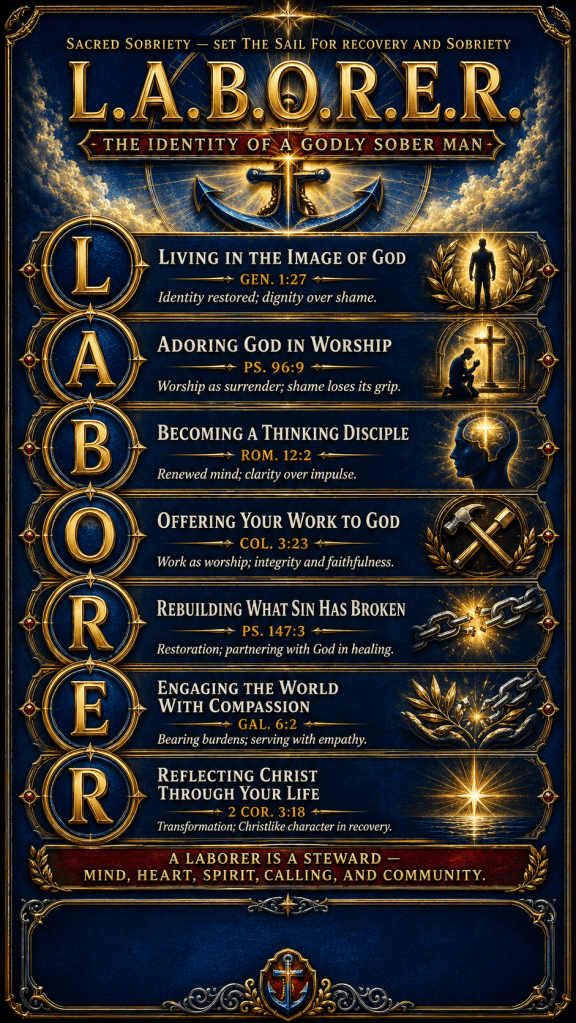
What does it actually mean to be a laborer in the Kingdom of God? Tozer’s vision — and Paul’s — is far deeper than simply “working hard.” To be a laborer means becoming a man who thinks clearly, worships sincerely, and works faithfully. It means engaging your mind, heart, and hands with intentionality. It means becoming a man of integrity and purpose, living out your faith and your sobriety with discipline, humility, and courage.
This is the making of a man. This is the path of recovery. This is the L.A.B.O.R.E.R. identity. Let’s walk through it together.
L — Living in the Image of God - Anchor Verse: “So God created humankind in his image…” — Genesis 1:27. Tozer begins with identity: you were created in the image of God. Recovery starts here. Addiction tries to convince you that you are broken beyond repair, defined by your past, or trapped in your failures. But Scripture declares that you bear the imprint of your Creator. Living in the image of God means reclaiming dignity, purpose, and worth. It means seeing yourself not through the lens of shame, but through the truth of who God says you are. In recovery, this becomes the foundation for every step forward.
A — Adoring God in Worship - Anchor Verse: “Worship the Lord in the splendor of holiness.” — Psalm 96:9. Tozer insists that man’s highest calling is worship. Worship is not a song; it is surrender. It is the posture of a man who knows he cannot heal himself. Worship awakens the spirit, softens the heart, and restores communion with God. In recovery, worship becomes the place where shame loses its grip and identity is restored. A laborer is a worshiper — a man who bows before God so he can stand in strength.
B — Becoming a Thinking Disciple - Anchor Verse: “Be transformed by the renewing of your minds.” — Romans 12:2. Addiction clouds the mind; recovery clears it. Tozer emphasizes that man was created “to think,” to reason, to observe, to inquire. A laborer engages his mind — he examines his thoughts, challenges his impulses, and submits his reasoning to the truth of Scripture. Becoming a thinking disciple means refusing to live on autopilot. It means choosing clarity over confusion, truth over lies, and wisdom over impulse. This is where transformation begins.
O — Offering Your Work to God - Anchor Verse: “Whatever you do, work at it with all your heart, as working for the Lord.” — Colossians 3:23. Work is not punishment; it is purpose. Tozer argues that a man is incomplete until he becomes a working man — one who puts his whole personality into meaningful labor. A laborer offers his work to God: his job, his responsibilities, his recovery, his relationships, his service. Work becomes worship when it is done with integrity, humility, and faithfulness. In recovery, this means showing up, keeping commitments, rebuilding trust, and contributing to the world around you.
R — Rebuilding What Sin Has Broken - Anchor Verse: “He heals the brokenhearted and binds up their wounds.” — Psalm 147:3. Tozer’s image of the world as a “bombed city” mirrors the internal landscape many men face in recovery. Addiction leaves ruins — damaged trust, fractured families, emotional wounds, spiritual emptiness. But a laborer does not run from the rubble; he rebuilds. He partners with God in the slow, steady work of restoration. Recovery is not about pretending the ruins aren’t there; it’s about letting God rebuild them with grace, patience, and truth.
E — Engaging the World with Compassion - Anchor Verse: “Bear one another’s burdens, and in this way you will fulfill the law of Christ.” — Galatians 6:2. A laborer does not live for himself. He engages the world with compassion, humility, and service. Recovery teaches a man to see others with empathy — to recognize pain, to offer support, to walk alongside those who struggle. Tozer reminds us that the world is full of wounded people waiting for healing hands. A laborer becomes those hands. He becomes a man who serves, encourages, and strengthens others as he himself is strengthened by God.
R — Reflecting Christ Through Your Life - Anchor Verse: “We… are being transformed into his image with ever‑increasing glory.” — 2 Corinthians 3:18. This final “R” brings the acrostic full circle. A laborer reflects Christ — in his thinking, his worship, his work, his relationships, his recovery, and his daily conduct. Tozer says that when a man becomes a thinker, a worshiper, and a worker, “some modest approach at least has been made toward Christlikeness.” Recovery is not merely about sobriety; it is about transformation. A laborer becomes a living testimony of God’s grace — a man whose life reflects the character, compassion, and courage of Jesus.
A laborer is a steward — a man entrusted with responsibility. Stewardship over your mind, heart, and spirit. Stewardship over your relationship with your Heavenly Father and the grace He has given you. Stewardship over your brothers and sisters in the fellowship of recovery. This is worship. And finally, stewardship over your vocation, your calling, your ministry, your family, and your community.
Thoughtful Reflection
As we step back from Tozer’s insights and Paul’s exhortation, a clear picture begins to emerge: God is not merely calling us to sobriety; He is calling us into transformation. The L.A.B.O.R.E.R. identity is not another checklist to complete or standard by which to measure our worth. It is a portrait of the man God is patiently shaping us to become—a man who thinks with clarity, worships with sincerity, works with integrity, and reflects the image of God not only through what he believes but also through how he lives. Recovery becomes the workshop where this transformation unfolds, slowly and steadily, through grace, surrender, and the supernatural work of the Holy Spirit.
One of the greatest challenges in recovery is learning to see ourselves truthfully—not through the distorted lens of shame, failure, regret, or fear, but through the compassionate eyes of our Heavenly Father. Tozer reminds us that we were created in the image of God, while Paul teaches that we are being transformed into the image of Christ. That means your past does not have the final word. Your addiction does not define you. Your failures do not determine your worth. God does. He calls you His workmanship, His beloved, and His son. The L.A.B.O.R.E.R. framework helps us begin reclaiming that God-given identity, not all at once, but one faithful and courageous step at a time.
This is why recovery can never remain passive. It is not simply something that happens to us; it is a process in which we actively participate—with God, within a community, and through the courage to keep showing up. Tozer’s image of a bombed city is not intended to leave us discouraged but to awaken us to the work of restoration. Yes, there may be ruins. There may be damaged relationships, broken trust, painful memories, and areas of life that need rebuilding. Yet God meets us in the rubble, not to condemn us for what has fallen apart, but to restore what sin and addiction have damaged. He invites us to join Him in that work by thinking clearly, worshiping sincerely, laboring faithfully, and learning to live with renewed purpose. This is where healing begins to deepen into transformation.
As you continue moving forward, remember that God is not asking you to become perfect overnight. He is asking you to remain willing—willing to think, willing to worship, willing to work, willing to surrender, and willing to grow into the man He created you to be. The L.A.B.O.R.E.R. identity is not a destination we reach once and for all; it is a lifelong journey marked by grace, guided by wisdom, and strengthened by the Spirit. Every honest decision, every act of surrender, and every faithful step forward move us closer to Christlikeness, integrity, and spiritual maturity.
Call to Action - Living This Out Today
James does not mince words when he writes, “Be doers of the word, and not merely hearers who deceive themselves.” Recovery is not sustained by information alone. Transformation requires application. It requires movement. It requires obedience. A man can hear truth every day of his life and remain unchanged — but the moment he begins to do what God says, everything shifts. The L.A.B.O.R.E.R. identity is not meant to sit on a page; it is meant to be lived.
So here is your challenge for today — and for the rest of this week:
1. Choose One Area to Steward Intentionally: Pick one area of your life — your mind, your worship, your work, your relationships, or your recovery — and commit to stewarding it with intentionality. Not perfectly. Not dramatically. Just faithfully. Ask God, “What is one step of obedience You are asking me to take today?” Then take it.
2. Practice One Act of Worship Outside of Sunday: Worship is not confined to a service; it is the posture of a surrendered heart. This week, choose one intentional act of worship:
- A moment of prayer
- A time of silence
- A Scripture reading
- A gratitude list
- A song that lifts your spirit Let your heart reconnect with the God who is shaping you.
3. Do One Act of Quiet, Faithful Work: Paul’s command in 2 Thessalonians 3:12 is simple: “Do your work quietly and earn your own living.” This week, do one task — big or small — with excellence, humility, and integrity. Show up. Follow through. Let your work become worship.
4. Encourage One Person in Their Recovery: A laborer does not walk alone. Reach out to someone — a brother in recovery, a friend, a family member — and offer encouragement. A text. A prayer. A check‑in. A reminder that they matter. This is how we bear one another’s burdens.
Your Final Charge - Do not merely hear this message. Do not merely admire it. Do not merely agree with it.
Live it. Let God shape you into a man who thinks with clarity, worships with sincerity, and works with integrity. Let Him form you into a L.A.B.O.R.E.R. — a man whose life reflects the image of Christ in every thought, every choice, and every step. You are not who you were. You are not who you used to be. You are becoming who God created you to be. And He is with you — every step of the way.


No comments:
Post a Comment